
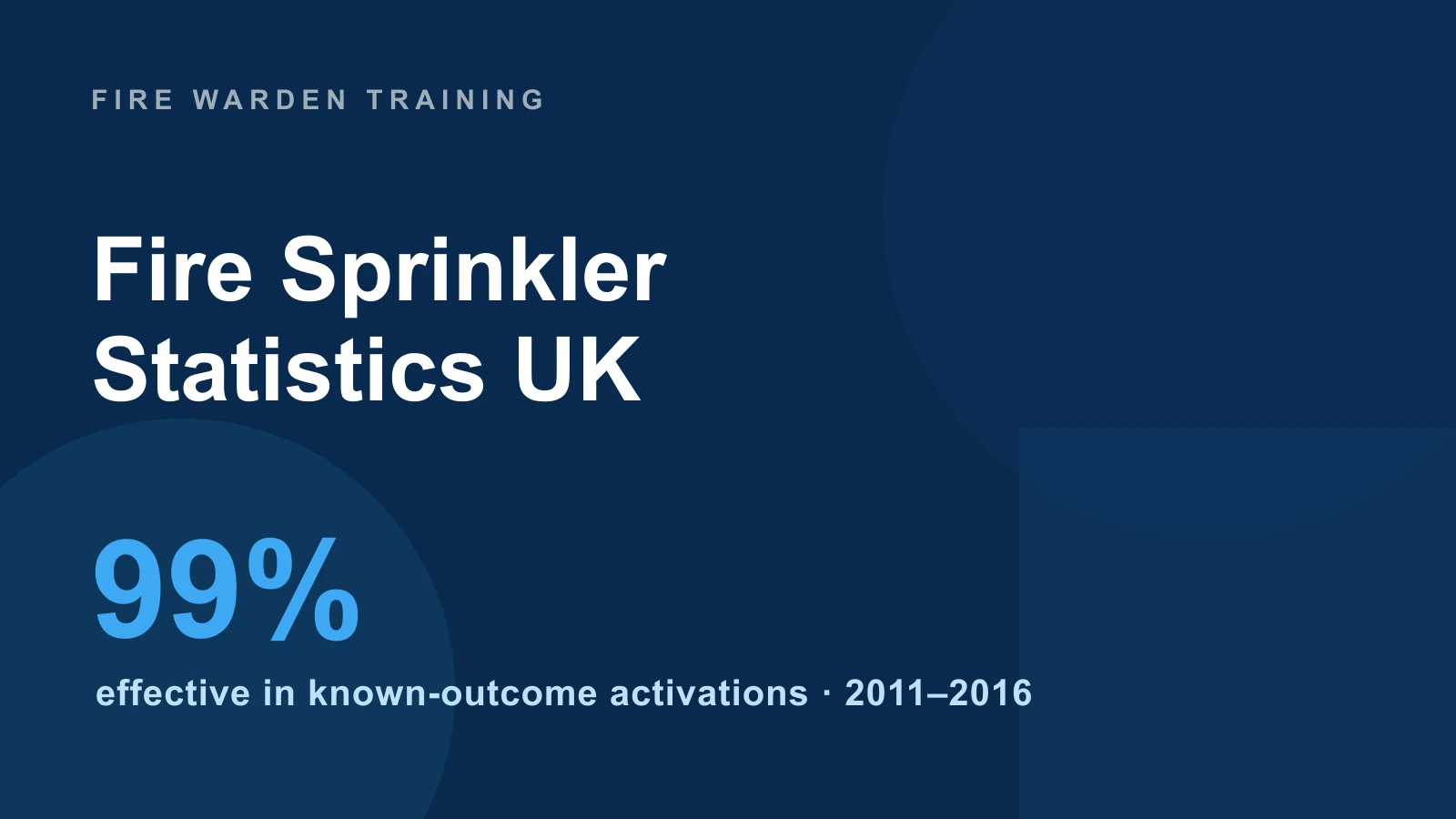
The widely quoted 99% sprinkler effectiveness figure comes from NFCC/NFSN research published in 2017 using 2011–2016 incidents. It concerns activations with a known outcome, not every installed system. This page separates that historical research from BAFSA’s newer 2025/26 incident review and current building guidance.
Statistics on system presence, activation, known outcomes and casualties use different denominators. Read the period and coverage with each figure. None is a guarantee for an individual building or a reason to delay evacuation, maintenance or reporting a fire.
Key facts and figures
- 99% — reported effectiveness among known-outcome activations in the 2017 NFCC/NFSN study of 2011–2016 incidents.
- 94% — the historical study’s reported operational reliability measure; not the share of every building fire triggering sprinklers.
- 677 activations had a known impact in that research, out of 945 recorded activations and 2,294 incidents examined.
- 86 incidents were reported to BAFSA’s Sprinkler Saves project for 2025/26; this is a selected log, not the national total.
- 48 extinguished / 32 controlled — outcomes among those 86 reports; six had other or unknown outcomes.
- 737 primary building fires with automatic water suppression present and having an impact in BAFSA’s separate England, Scotland and Wales FOI dataset for 2024/25.
- 47 of the 86 project reports for 2025/26 concerned dwellings: 45 with sprinklers and two with water mist.
- Over 11m — England’s Approved Document B sprinkler guidance for blocks of flats; new care homes are covered irrespective of height from March 2025, subject to transitional arrangements.
Checked on 15 October 2026. Historical NFCC/NFSN research, the 2025/26 Sprinkler Saves project log and BAFSA’s separate 2024/25 FOI dataset are labelled independently. Some chart captions in the 2025/26 review retain an earlier year; this page uses the explicit dataset descriptions and totals in its text.
How effective are fire sprinklers in the UK?
The 2017 research reported 99% effectiveness: 62% of known outcomes were containment or control and 37% extinguishment. The 2019 supplementary report repeats these results and identifies their 2011–2016 observation period.
Of 2,294 incidents examined, 945 involved activation, but only 677 had a known impact. The 99% headline therefore does not cover all 945 activations. Missing outcomes and the distinction between a system being present and operating matter when interpreting the percentage.
Containment and extinguishment are different outcomes. A system may restrict fire growth while further firefighting is still required. Its performance depends on its design, coverage and condition; an historical aggregate cannot guarantee tenable conditions or safe escape time in a specific incident.
How often do sprinklers activate and work?
The historical study reports 94% operational reliability. Its discussion distinguishes non-operation when a system was not expected to act from cases where it should have operated. This is not a claim that sprinklers activate at 94% of all fires.
Ordinary automatic sprinkler heads respond individually to sufficient heat; a smoke alarm does not normally release every head. Different suppression designs exist, so operating arrangements should be checked against the actual installation rather than inferred from a general description.
BAFSA’s latest review gives 737 primary building fires in its 2024/25 England, Scotland and Wales FOI dataset, compared with 740 in 2023/24. These are reported incidents with suppression present and having an impact. They do not count installations or prove that changes were caused by wider installation.
What do sprinkler activations look like in homes?
The 2025/26 Sprinkler Saves log includes 47 dwelling incidents, alongside 39 in other building categories. This is a collection of submitted cases. The table below covers all 86 reports across building types, not dwellings alone; percentages are calculated and rounded.
| Outcome in all 2025/26 project reports | Incidents | Share of 86 |
|---|---|---|
| Fire extinguished | 48 | 56% |
| Fire contained or controlled | 32 | 37% |
| Not controlled or outcome unknown | 6 | 7% |
| Total reported incidents | 86 | 100% |
The separate FOI dataset in the same review covers 2024/25 and includes 266 dwelling fires, with 246 recorded as having sprinklers and 20 water mist. Do not combine these counts with the 2025/26 project log or treat either as the number of protected homes.
Do sprinklers save lives and reduce injuries?
The 2019 supplementary study found lower injury rates in its sprinkler-associated comparisons and no recorded non-dwelling fatalities in the period examined. It also recorded five deaths in dwellings with fixed systems. These are historical observations, not proof that deaths cannot occur where sprinklers are fitted.
Comparisons between buildings with and without systems can be affected by occupancy, vulnerability, fire type and coverage. The study’s casualty-treatment percentages should not be turned into a guaranteed personal reduction in risk, or a prediction for every building type.
Suppression is one part of a fire strategy alongside prevention, detection, compartmentation and escape arrangements. See our evacuation statistics for related evidence. The presence of sprinklers does not remove the need to follow the building’s emergency plan.
Are sprinklers a legal requirement in UK buildings?
England’s Approved Document B recommends sprinklers throughout blocks of flats with a storey more than 11 metres above ground level. The 2020 amendment took effect on 26 November 2020 with transition provisions. Approved Documents are statutory guidance on meeting Building Regulations, not the regulations themselves.
Requirements and guidance differ across the UK. The table summarises selected provisions, not every building type or exception. The applicable edition and transitional arrangements depend on the work and approval dates:
| Nation | Requirement | In force from |
|---|---|---|
| England | ADB guidance for blocks of flats with a storey over 11m; new care homes irrespective of height | Flat threshold: November 2020; care homes: March 2025; transitions apply |
| Wales | Automatic suppression for specified new and converted residential premises under Building Regulations | Domestic extension from January 2016; check current scope and exceptions |
| Scotland | Separate mandatory standard 2.15 and technical handbooks, including flats and maisonettes | Use applicable handbook; April 2026 changes include specified hotel conversions |
England’s guidance also provides for sprinklers in all new care homes irrespective of height from 2 March 2025, subject to transition provisions. An existing block is not automatically subject to a blanket retrofit duty solely because it is over 11 metres, though building work and other duties can require further assessment. Wales now implements its domestic suppression requirements through Building Regulations; the 2011 Measure was repealed.
How do sprinklers compare with water mist?
In BAFSA’s 2024/25 FOI dataset, 548 incidents involved sprinklers and 189 water mist. These add to 737 incident records. The split is not a measure of the installed market, and differences in incident mix prevent a simple comparison of the technologies’ effectiveness.
Sprinklers and water mist have different design and application requirements. A system must be suitable for the hazards and building concerned, with adequate design evidence, commissioning and maintenance. A technology label alone does not establish equivalent performance.
The historical 99% and 94% findings should not be assigned to every water-mist system or treated as universal product ratings. Check the actual system specification and the limits of the evidence before making claims about its performance.
Frequently asked questions
How effective are fire sprinklers in the UK?
The 2017 NFCC/NFSN research reported 99% effectiveness among activations with known outcomes, using 2011–2016 incidents. That historical percentage is not a current guarantee for all systems.
How often do sprinklers actually activate and work?
The historical research’s reported reliability measure was 94%. Activation depends on sufficient heat reaching a head and on system coverage and condition; not every fire requires or triggers operation.
Are sprinklers a legal requirement in UK buildings?
Provisions differ by nation, building type and work date. England’s Approved Document B includes the over-11m flat-block threshold and guidance for all new care homes, with transitional arrangements. Wales and Scotland have separate requirements.
Do sprinklers save lives and reduce injuries?
Research supports a protective role, but systems have limits and deaths can still occur. Historical comparisons of casualties are not a guaranteed personal risk reduction. Prevention, detection and the premises escape plan remain necessary.
Where do UK fire sprinkler statistics come from?
Sources include the dated NFCC/NFSN research, MHCLG’s England incident datasets, BAFSA’s 2025/26 project review and separate FOI data, and each nation’s building legislation and guidance.
Sprinklers and water mist are only one layer of fire safety — they control the fire, but a trained team still has to get everyone out and account for them. Our Fire Warden Training course covers evacuation, area sweeps, assembly-point management and everyday fire safety checks — £18 per learner, RoSPA approved and CPD accredited, 60 to 90 minutes online, with an instant certificate on passing and bulk discounts from 10 delegates.
Related guides
- High-Rise Fire Statistics UK: Buildings, Cladding & Risk Data
- Fire Evacuation Statistics UK: Rescues, Drills & Behaviour Data
- Fire Door Statistics UK: Failures, Inspections & Compliance
- Fire and Rescue Service Statistics UK: Incidents, Stations & Funding
- Fire marshal: a complete UK guide to the role, duties and training
Sources & references
- NFCC / NFSN — March 2019 supplementary report, including the 2017 study’s definitions
- BAFSA — Sprinkler Saves Review 2025/26 (project log and separate 2024/25 FOI data)
- MHCLG — Official England sprinkler/water-mist incident extract, 2018/19–2023/24
- GOV.UK — Current Approved Document B and amendment editions
- GOV.UK — Care-home sprinkler amendment and transition arrangements
- Welsh Government — Repealed 2011 Measure and Building Regulations route
- Scottish Government — Current building standards and technical handbooks
Suppression controls the fire — a trained team still gets everyone out safely. Get your staff certified with accredited, workplace-ready fire warden training.
Explore the Fire Warden Training course →
Mark writes about workplace health & safety, fire safety and accredited online training for Fire Warden Training, part of Online CPD Academy.