
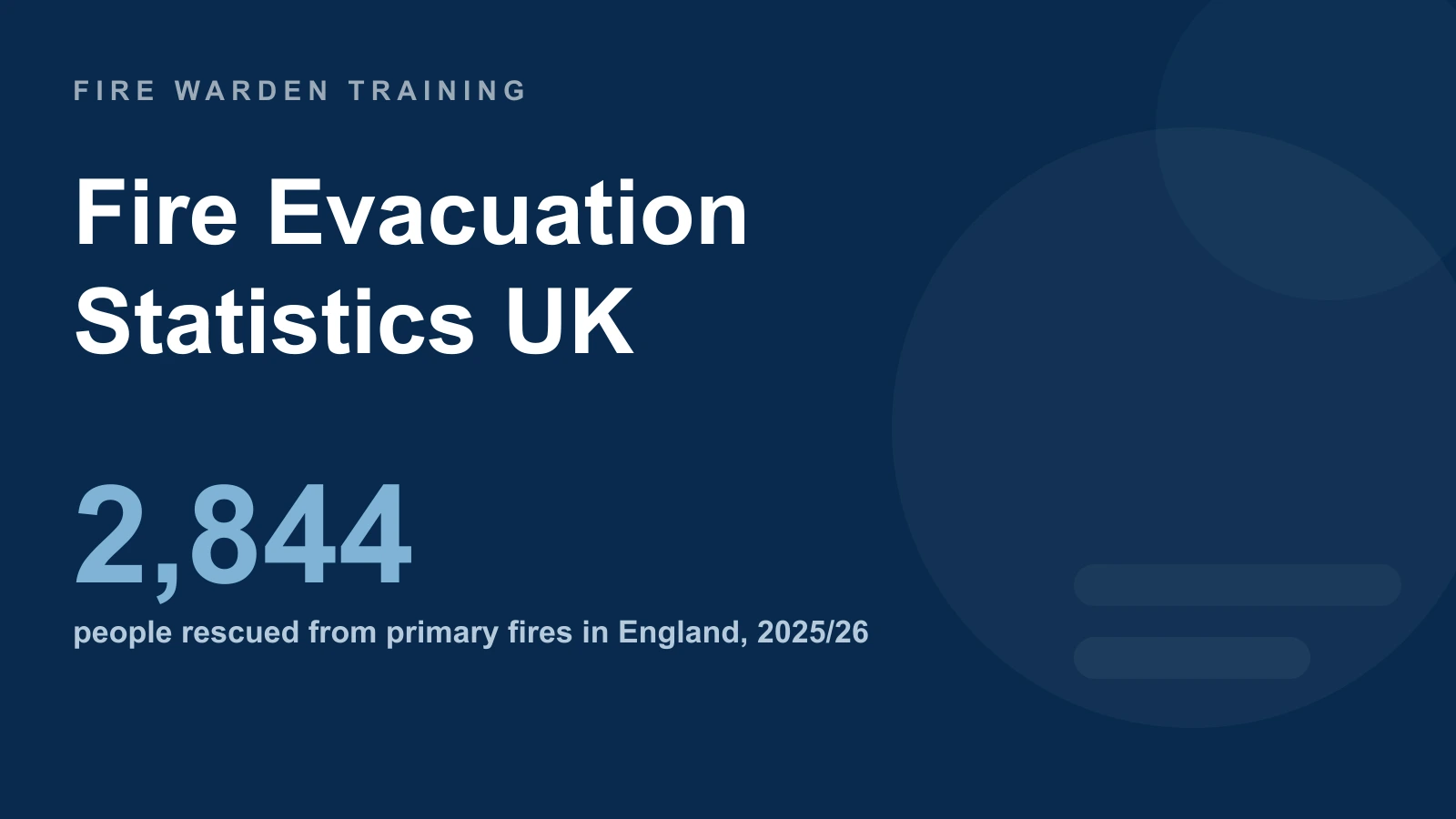
In the year ending March 2026, fire and rescue services in England rescued 2,844 people from primary fires. The published dwelling-fire evacuation table records 982 incidents involving evacuation. This page combines those official statistics with household preparedness data and a separately identified, dated workplace survey.
It’s written for anyone who needs citable numbers on how evacuations actually go — how many people get rescued, how many fires force an evacuation, whether workplaces are drilling, and what changed after Grenfell. Every figure is dated and sourced, and the official statistics are separated clearly from the survey data.
Key facts and figures
- 2,844 people rescued from primary fires in England, year ending March 2026 — down 4.3% from the revised 2,973 in 2024/25.
- 982 dwelling-fire incidents involving evacuation in England in 2025/26; this is an incident count, not a people count.
- 47% of respondents could not locate their workplace assembly point in a provider survey published in February 2024.
- 16% reported a workplace drill in the previous year in that survey; this does not measure the proportion of workplaces holding drills.
- 44% reported not knowing what to do during a workplace fire in the same dated survey.
- 6 April 2026 — England’s residential evacuation-plan regulations came into force for specified residential buildings.
- 93% of English households reported a working smoke alarm in 2024/25; 24.2% of households with alarms said they never tested them.
- 184 dwelling-fire fatalities in England in 2025/26 — around 72% of the 254 fire fatalities.
Checked on 15 October 2026. Official rescue and dwelling-evacuation figures use FIRE0511; survey findings are from a provider’s 2024 publication and are not official national estimates. Reporting periods and populations differ.
How many people are rescued from fires in the UK?
2,844 people were rescued from primary fires in England in 2025/26, compared with a revised 2,973 in 2024/25, a fall of 4.3%. FIRE0511 records 2,084 rescues at dwelling fires, 559 at other-building fires, 148 at vehicle fires and 53 at other outdoor primary fires.
Primary fires include building and vehicle fires and other fires meeting the official criteria, such as those involving casualties or rescues. The rescue count concerns people assisted by fire and rescue services; it does not count everyone who leaves a building independently.
The series records 4,367 rescues in 2009/10, so the 2025/26 total is about 35% lower. Annual movements can differ from that long-term trend. Revised historical figures should be used when calculating year-on-year changes.
What about Wales and Scotland?
FIRE0511 covers England. Wales and Scotland publish their own incident statistics. Figures from the separate systems should retain their own reporting periods and definitions rather than being labelled a single UK rescue total.
How many fires involve an evacuation?
The published FIRE0511 dwelling table records 982 dwelling-fire incidents involving evacuation in England in 2025/26, compared with 963 in 2024/25, an increase of 2%. Of the latest incidents, 921 involved 1–5 people, 49 involved 6–20, 11 involved 21–50 and one involved 51–100.
This counts incidents at dwelling fires, not the number of people evacuated across all premises. It excludes planned drills and evacuations associated solely with false alarms. It must not be presented as a count of all UK evacuations.
For fire wardens, it provides context on evacuations at recorded fires. It cannot establish how frequently workplaces practise evacuation or how effective their arrangements are.
Are fire rescues and evacuations falling over time?
Between 2009/10 and 2025/26, rescues from primary fires in England fell from 4,367 to 2,844, around 35%. Dwelling-fire incidents involving evacuation fell from 2,760 to 982, around 64%. These are different populations: the rescue series covers all primary fires, while this evacuation comparison covers dwellings.
The latest annual changes differ: rescues fell 4.3%, while dwelling evacuation incidents rose 2%. These descriptive statistics do not identify the causes of either movement or predict what will happen next.
| Measure | Latest figure | Data period | Trend |
|---|---|---|---|
| People rescued from primary fires, England | 2,844 | 2025/26 | Down 4.3% annually; down about 35% since 2009/10 |
| Dwelling fires involving evacuation, England | 982 | 2025/26 | Up 2% annually; down about 64% since 2009/10 |
| Survey respondents unable to locate assembly point | 47% | Provider survey published February 2024, n=1,500 | Not a national workforce estimate |
| Survey respondents reporting a drill in previous year | 16% | Same 2024 provider survey | Not the share of workplaces holding drills |
| Dwelling-fire fatalities, England | 184 | 2025/26 | About 72% of all fire fatalities |
| Households reporting a working smoke alarm, England | 93% | 2024/25 | Self-reported; 92% the previous year |
Whether an evacuation succeeds also depends on the building’s fire precautions and escape arrangements. Our companion page on fire door statistics explains the scope of published inspection findings.
What do UK fire drill statistics show?
A Phoenix Health & Safety survey of 1,500 UK participants, published on 15 February 2024, reported that 16% had taken part in a workplace fire drill in the previous year. This is a dated provider survey, not an official or current national estimate of drill frequency.
Government workplace guidance recommends at least one drill a year and recording the results. The Fire Safety Order requires appropriate emergency procedures, including safety drills. A participant survey cannot establish that 84% of workplaces breached their duties: respondents and workplaces are different units of measurement.
The provider also reported that 44% would not know what to do during a workplace fire and 24% knew which extinguisher to use. These findings describe the survey responses; they do not prove the effects of training or represent a current compliance rate. Drills should test the actual site procedure and inform any necessary improvements.
How many workers know where their fire assembly point is?
The same February 2024 survey reported that 47% of respondents could not locate their workplace fire assembly point. This finding should not be extended to nearly half of the entire UK workforce without evidence that the survey supports that inference.
Assembly arrangements help those managing an evacuation account for people and pass information to attending crews. Missing-person information must be communicated promptly; staff should not re-enter a building to look for someone.
Brief staff on the site’s assembly arrangements, provide appropriate signs and check understanding during drills. Changes to routes, work areas or staffing may require the arrangements and briefings to be reviewed.
Who needs help to evacuate? PEEPs and the Grenfell legacy
The Grenfell Tower Inquiry recommended better arrangements for residents who need help to evacuate. England’s residential evacuation-plan regulations implement a defined process for identifying relevant residents, assessing their needs and agreeing appropriate arrangements.
The rules took effect on 6 April 2026. They cover buildings with at least two domestic premises that are at least 18 metres high or have at least seven storeys, and buildings over 11 metres with simultaneous evacuation strategies. Residents’ participation is voluntary; prescribed information can be shared with the fire and rescue authority only with explicit consent. Responsible persons must offer assessments, consider reasonable and proportionate measures and seek agreement on a written evacuation statement.
Workplaces must provide suitable escape arrangements for people who need assistance. A personal plan should reflect the individual, premises and available support. Responsibilities for preparing and implementing it must be allocated; there is no general rule preventing a suitably competent fire warden from contributing. Residential and workplace arrangements have different legal and practical contexts.
How prepared are households to evacuate?
In the English Housing Survey 2024/25, 93% of households reported at least one working smoke alarm, compared with 92% the previous year. Among households with alarms, 24.2% said they never tested them. These are household reports rather than physical tests by the survey team.
England recorded 184 dwelling-fire fatalities in 2025/26, about 72% of all 254 fire fatalities. The distribution does not establish why a particular death occurred or support attributing deaths to the absence of workplace-style wardens and drills.
Households should plan how to escape, keep routes clear and understand their building’s fire instructions. People in blocks of flats should follow the building-specific plan and fire-service advice; a single generic instruction cannot cover every building and situation.
Frequently asked questions
How often should you have a fire drill at work in the UK?
Government guidance recommends at least one workplace drill each year and recording the results. The risk assessment and work arrangements may require more frequent practice. A provider survey published in February 2024 reported that 16% of its respondents had participated in a drill in the previous year; that is not a national compliance rate.
How many people are rescued from fires in England each year?
FIRE0511 records 2,844 people rescued from primary fires in England in 2025/26, down 4.3% from the revised 2,973 in 2024/25.
How many people are evacuated in fires in the UK?
The published dwelling-fire table records 982 incidents involving evacuation in England in 2025/26. This is a count of dwelling-fire incidents, not the number of people evacuated throughout the UK.
What percentage of workers know where their fire assembly point is?
A Phoenix Health & Safety survey published in February 2024 reported that 47% of its 1,500 participants could not locate their workplace assembly point. It is a dated survey result, not a current official workforce estimate.
What is a PEEP and when did they become mandatory?
A PEEP sets out personal evacuation arrangements. England’s residential regulations began on 6 April 2026 and cover specified buildings: at least 18 metres or seven storeys, or over 11 metres with simultaneous evacuation, with at least two domestic premises. Relevant residents participate voluntarily. Workplace escape arrangements are governed separately by workplace fire-safety duties.
Where do UK fire evacuation statistics come from?
Official England figures come from MHCLG’s FIRE0511 tables and other fire-statistics releases. The English Housing Survey reports household alarm ownership and testing. Workplace survey findings are separately identified and dated; Wales and Scotland publish their own fire statistics.
If you’re responsible for evacuation where you work, these figures provide context for reviewing your arrangements. Our Fire Warden Training course covers evacuation procedure, sweeps, assembly-point management and PEEPs — £18 per learner, RoSPA approved and CPD accredited, 60 to 90 minutes online, with an instant certificate on passing and bulk discounts from 10 delegates.
Related guides
- Fire Door Statistics UK: Failure Rates, Inspections & Compliance Data
- High-Rise Fire Statistics UK: Fires in Tall Buildings & Cladding Remediation Data
- Fire marshal responsibilities: the complete UK duties list
- Fire marshal checklist: daily, weekly and emergency procedure
- How many fire marshals do you need?
Sources & references
- MHCLG — FIRE0511 rescue and dwelling-fire evacuation tables, 2025/26
- MHCLG — English Housing Survey 2024/25, household smoke alarms
- GOV.UK — Residential PEEPs scope, duties and consent
- GOV.UK — Workplace fire drills and training
- GOV.UK — Workplace evacuation arrangements
- Legislation — Regulatory Reform (Fire Safety) Order 2005
- London Fire Brigade — Household escape plans
- Phoenix Health & Safety — Dated provider survey, 15 February 2024 (not official statistics)
Evacuation is the fire warden’s core duty — get certified with accredited, workplace-ready training.
Explore the Fire Warden Training course →
Mark writes about workplace health & safety, fire safety and accredited online training for Fire Warden Training, part of Online CPD Academy.