
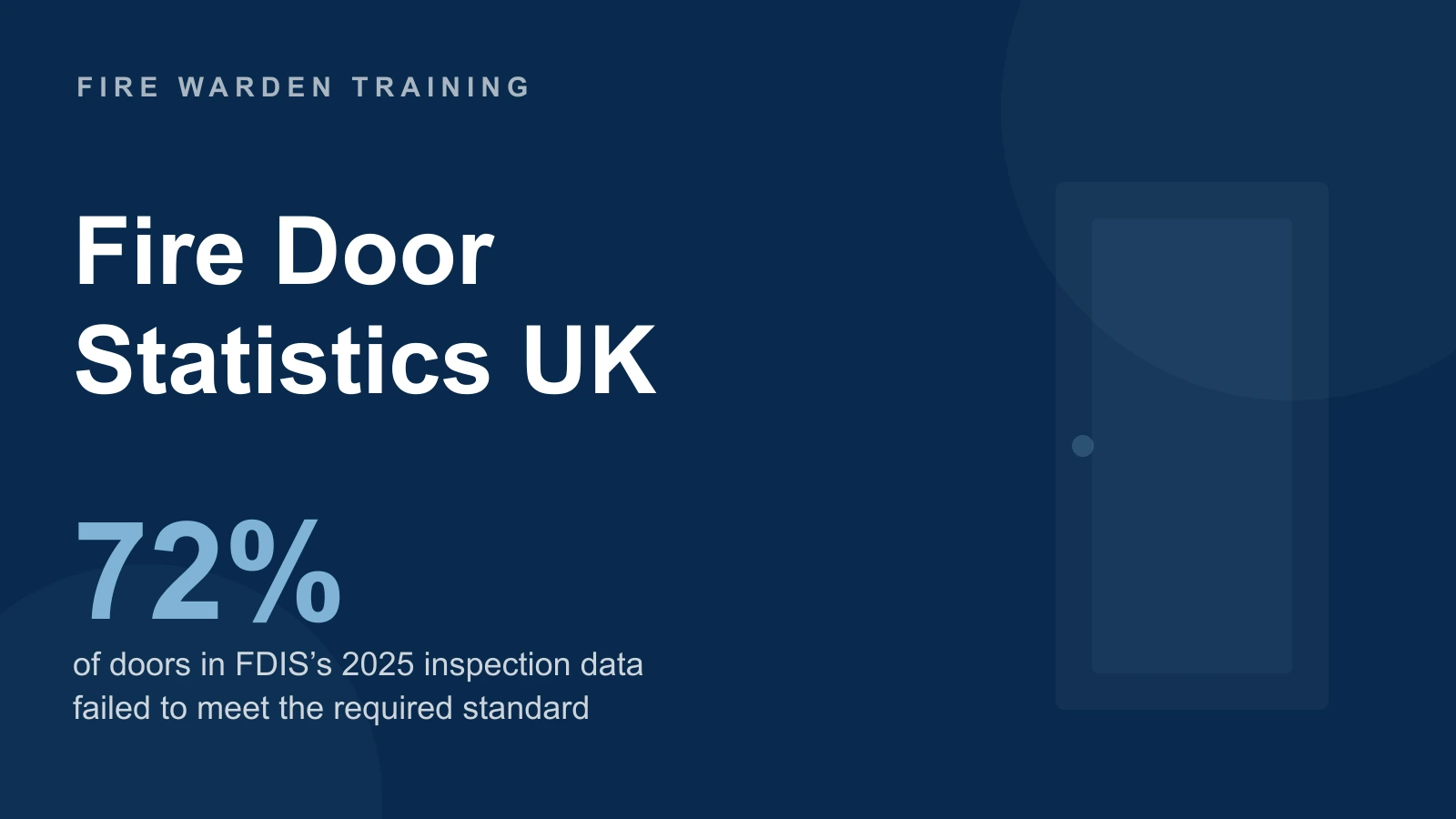
FDIS reports that 72% of the fire doors in its 2025 inspection data did not meet the required standard. That describes inspected doors, not a random sample of all UK doors. This page sets out the dated inspection findings, current awareness research, government test results and England’s legal checking duties, with their different scopes made clear.
Key facts and figures
- 72% — doors failing to meet the standard in FDIS’s 2025 inspection data; not a national prevalence estimate.
- 75% — the corresponding headline in the separate 2021 FDIS inspection dataset.
- 100,000+ inspections formed the 2021 dataset; it was not a census of UK fire doors.
- 25 timber fire-door designs passed government 30-minute tests from both sides in the 2018–19 programme.
- About 3 million fire doors were estimated to have been sold in the UK in 2013 in BWF’s March 2015 scheme manual; not a verified 2026 installation count.
- About 15 minutes — the test result for a Grenfell Tower composite door intended to resist fire for 30 minutes.
- 38% of Gen Z respondents aged 18–29 felt safe with a fire door wedged open in BWF’s 2026 survey.
- Quarterly communal-door checks in English residential buildings over 11 metres with two or more domestic premises; annual best-endeavours checks of flat entrance doors.
Checked on 15 October 2026. Inspection results cover 2025 and 2021; awareness research covers 2026; market estimates and government furnace tests are historical. These sources answer different questions and should not be combined as a single national failure rate.
What percentage of fire doors fail inspection?
FDIS’s own published account of its 2025 inspection data gives a 72% non-compliance rate. This concerns doors inspected through that scheme. Selection of premises and doors for inspection means the finding cannot establish that 72% of every fire door in the UK is defective.
The GAI, a founding partner of the scheme, reported 75% failing to meet standards in more than 100,000 inspections in 2021. Different inspected populations limit year-to-year comparisons. A failed inspection also does not establish that a door provides no resistance at all.
| Year | Reported finding | Scope |
|---|---|---|
| 2021 | 75% failed to meet standards | FDIS dataset of more than 100,000 inspections |
| 2025 | 72% failed to meet standards | FDIS inspection data; different inspected population |
| 2026 | 38% felt safe with a wedged-open door | BWF awareness survey: Gen Z respondents aged 18–29; not an inspection rate |
Inspection findings require an appropriate response, but the remedy depends on the defect and supporting door-set information. Some doors can be repaired; others need replacement. An aggregate failure percentage cannot determine whether work on a particular door will be minor, inexpensive or safe for a non-specialist to undertake.
What causes fire doors to fail inspection?
FDIS identifies excessive gaps, smoke-seal problems and inadequate care or maintenance as common reasons for inspection failure. Government guidance similarly asks checkers to look at the door, frame, seals and closing operation. These are defect categories, not current national percentages.
| Check area | What to look for | Evidence |
|---|---|---|
| Gaps around the door | Excessive or uneven gaps requiring assessment | FDIS findings; government guidance |
| Care and maintenance | Damage, loose components or impaired operation | FDIS findings; government guidance |
| Smoke seals | Missing, damaged or poorly fitted seals where required | FDIS findings; government guidance |
| Closing and installation | Door closes fully into its frame; compatible components | Government fire-door guidance |
A door can have several faults. Visible checks help identify problems, but they do not replace assessment of the complete door set where its performance is uncertain. Seals, hinges, glazing, frame, closer and door leaf must be compatible with the required performance.
Record and report defects, then arrange competent assessment or repair as appropriate. Do not trim a door, add incompatible components or alter a closer simply to make it appear to pass a quick check. The correct dimensions and components depend on the door’s specification and evidence.
How many fire doors are installed in the UK each year?
BWF’s March 2015 scheme manual estimated that approximately 3 million fire doors were sold into the UK market in 2013. This is a historical market estimate. It should not be described as a measured current annual installation total.
Sales, installed stock and inspected doors have different denominators. Multiplying an inspection failure percentage by annual door sales would not give a valid estimate of newly installed defective doors. Installation quality and ongoing maintenance both need to be assessed on their own evidence.
How common are wedged or propped-open fire doors?
BWF’s 2026 Fire Door Safety Week survey found that 38% of Gen Z respondents aged 18–29 felt safe when a fire door was wedged open, and 29% thought this was acceptable if smoke alarms were present. These are responses from that age group, not percentages of every UK resident or workplace.
Only 40% of Gen Z respondents said they understood the door’s role in slowing fire and smoke. These survey responses describe awareness; they do not count how many doors are actually wedged open. Smoke detection does not replace compartmentation.
The 2026 campaign was held on 21–25 September under the theme “Check it, close it: Protection starts at the door”. Report wedged doors and defects through the building’s reporting arrangements. Approved automatic hold-open systems that release the door appropriately are different from wedges used for convenience.
What did fire door testing find after Grenfell?
The government’s July 2018 account confirms that a glazed composite door from Grenfell Tower, manufactured by Manse Masterdor, failed a 30-minute fire-resistance test after approximately 15 minutes. The result triggered investigation of the wider market.
By July 2018, doors from five suppliers had failed the required tests, and known failed products had been withdrawn from sale. This was a finding about particular products tested; it does not establish the performance of every composite door.
In a separate programme from October 2018 to March 2019, all 25 timber door designs tested passed the 30-minute standard from both sides. The government expressly limited the results to the tested models and warned that they did not provide complete assurance for every door. Correct specification, installation and maintenance still matter.
What are the legal requirements for checking fire doors?
Since 23 January 2023, Regulation 10 requires quarterly checks of communal fire doors in English buildings over 11 metres containing two or more domestic premises. Responsible persons must use best endeavours to check flat entrance doors at least annually. Residents in buildings with two or more domestic premises must also receive relevant fire-door information.
For workplaces covered by the Fire Safety Order in England and Wales, fire precautions must be maintained in efficient working order and good repair. The risk assessment and relevant guidance inform the checking arrangements. There is no universal statutory weekly fire-warden inspection interval for every workplace.
Government guidance distinguishes routine Regulation 10 checks from a detailed technical assessment. Those doing checks need suitable instruction; concerns about fire resistance or required repairs may need specialist expertise. The published inspection percentages do not prove that new legislation caused an improvement.
Frequently asked questions
How many fire doors fail inspection in the UK?
FDIS reports 72% failing to meet the required standard in its 2025 inspection data. Its separate 2021 dataset reported 75%. These findings concern inspected doors and are not a representative national failure rate.
What is the most common fire door defect?
FDIS identifies excessive gaps, smoke-seal issues and care or maintenance problems among common defects. This page does not present unverified defect percentages as current national statistics.
How often should fire doors be inspected?
In English residential buildings over 11 metres with two or more domestic premises, communal fire doors require quarterly checks and flat entrance doors annual checks on a best-endeavours basis. Other premises need checking and maintenance arrangements appropriate to their risk assessment and duties.
Do failed fire doors need to be replaced?
Not automatically. The remedy depends on the defect and the evidence for the complete door set. A competent assessment should determine suitable repair or replacement; a survey percentage cannot establish what an individual door needs.
What is the Fire Door Inspection Scheme (FDIS)?
FDIS is the Fire Door Inspection Scheme, which provides a route to third-party certification of inspectors. Its published findings concern doors inspected through the scheme, rather than all UK fire doors.
When is Fire Door Safety Week?
The BWF’s 2026 campaign ran on 21–25 September with the theme “Check it, close it: Protection starts at the door”. “Recognise it, Report it” was the 2023 theme; the 2025 theme was “Fire Travels Fast”.
Checking fire doors — closed, undamaged, never wedged — is one of the highest-value routine duties a fire warden performs, and the statistics above show exactly why it matters. Our Fire Warden Training course covers fire door checks alongside the full warden role. £18 per learner, RoSPA approved and CPD accredited, 60 to 90 minutes online from any device, and an instant certificate on passing. Free unlimited retakes if you don’t pass first time, and bulk discounts from 10 delegates upwards.
Related guides
- Fire Evacuation Statistics UK: Rescues, Drills & Evacuation Behaviour Data
- High-Rise Fire Statistics UK: Fires in Tall Buildings & Cladding Remediation Data
- Fire marshal checklist: daily, weekly and emergency procedure
- Fire marshal responsibilities: the complete UK duties list
- How many fire marshals do you need?
Sources & references
- FDIS — Scheme’s own 2025 inspection-data announcement
- Guild of Architectural Ironmongers — FDIS 2021 inspection findings
- BWF — Fire Door Safety Week campaigns and historical awareness surveys
- BWF — 2026 age-specific awareness survey
- BWF — March 2015 scheme manual, historical 2013 market estimate
- MHCLG — Composite-door test findings, July 2018
- MHCLG — Timber fire-door test conclusions, 2018–19
- GOV.UK — Fire Safety (England) Regulations: fire-door guidance
- Legislation.gov.uk — Fire Safety Order maintenance duty
Fire door checks are a core fire warden duty — learn to do them properly with accredited training.
Explore the Fire Warden Training course →
Mark writes about workplace health & safety, fire safety and accredited online training for Fire Warden Training, part of Online CPD Academy.