
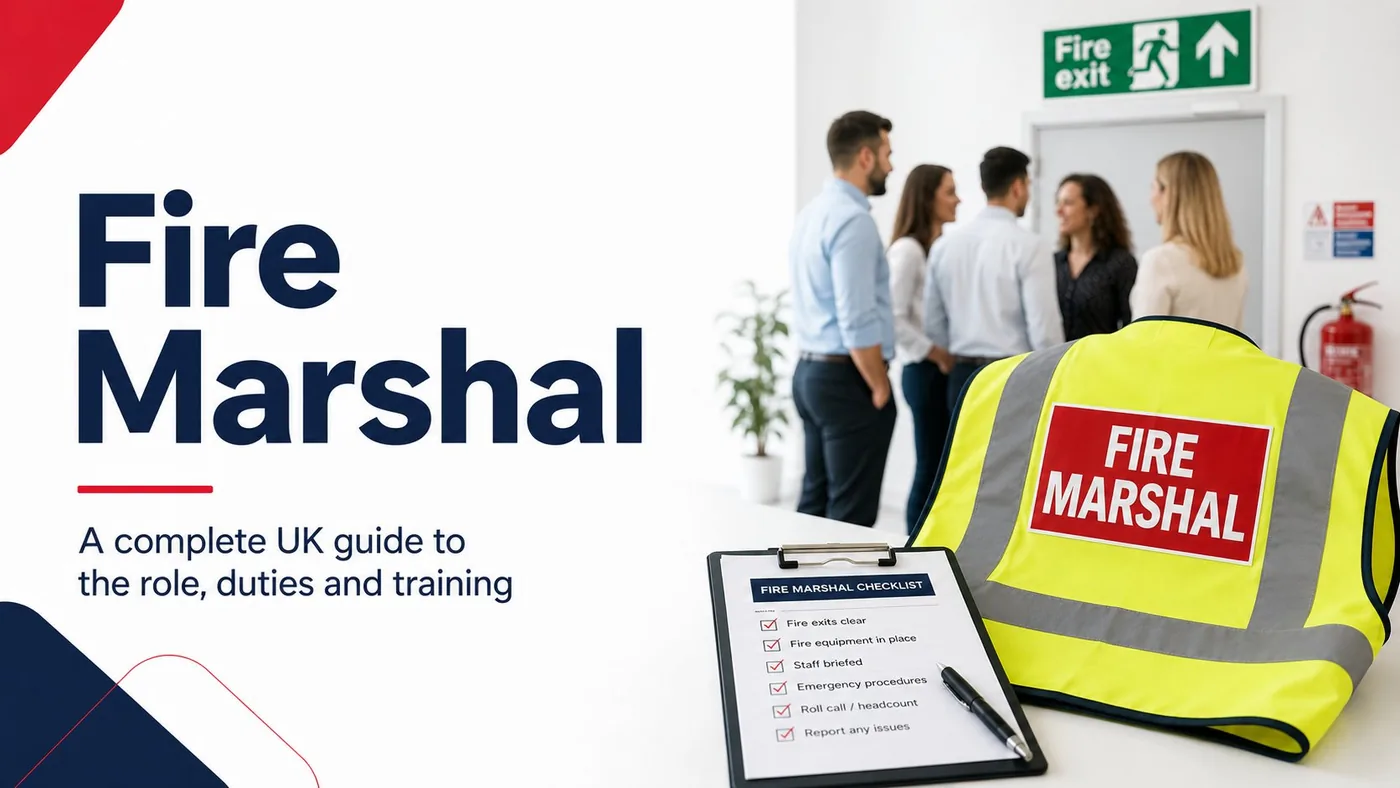
Fire marshal and fire warden mean the same thing in UK workplaces. Both terms describe a trained employee who supports fire safety on the premises — checking exits and equipment day-to-day, leading the evacuation if something goes wrong, and helping the person legally responsible for fire safety meet their duties under the law.
If you’ve been asked to become one, or you’re working out whether your business needs them, this guide covers the role end-to-end. We’ll go through what fire marshals actually do, the legal background, how many you should appoint, what training looks like, and the equipment they’re expected to have to hand.
What is a fire marshal?
A fire marshal is a regular member of staff — not a firefighter, not an inspector, not someone with statutory enforcement powers. They’re an employee who has been nominated for the role, given the relevant training, and made part of the workplace’s fire safety arrangements.
The role combines prevention and emergency duties. Routine work may include checks of doors, exits, equipment and housekeeping. During an alarm, marshals follow the premises’ plan, assist evacuation within their training and report from safety; any sweep must stop if conditions are unsafe.
In England and Wales, articles 13, 15 and 18 of the Fire Safety Order cover nominated assistance, emergency arrangements and competent safety assistance. The law does not prescribe the titles “fire marshal” or “fire warden”. Scotland and Northern Ireland have separate fire-safety legislation.
The role exists right across the UK economy — offices, factories, shops, restaurants, schools, care homes, warehouses, hotels, theatres, leisure centres. Anywhere with staff and visitors and a fire risk worth managing, which is essentially everywhere.
Fire marshal vs fire warden — same role?
Yes. UK fire safety law makes no distinction between a fire marshal and a fire warden. The terms are used interchangeably across industries — some sectors prefer “warden”, others prefer “marshal”, and many workplaces treat them as straightforward synonyms.
The confusion comes mostly from the United States, where a “fire marshal” is a uniformed official with investigation and enforcement powers — closer to what we’d call a fire investigator or fire inspector here. That’s a different role entirely, and not the one we’re talking about.
Some organisations assign the two titles different duties, such as checking zones or coordinating assembly points. Document the actual responsibilities and training. Nobody should remain inside solely to be the last person out.
What does a fire marshal do?
Day-to-day, a fire marshal is checking that the workplace’s fire safety arrangements are still working. Are the fire doors closing properly? Is the corridor near the kitchen still clear, or has someone stacked boxes against the exit? Is the extinguisher still in place with its safety pin intact? Was the weekly alarm test logged?
Routine checks can identify blocked exits, wedged doors, damaged equipment and other defects before an emergency. They complement the fire risk assessment and maintenance programme; they do not guarantee that a fire will not occur.
A typical week for a marshal in an average office might look like this. Monday morning: walk the floor, check exits and corridors are clear, verify fire doors are functioning. Wednesday: be present for the weekly alarm test and log it. Thursday: brief a contractor coming in to do work in the server room about exit routes and the assembly point. Friday: spot-check that the new starter who joined that week knows where the assembly point is. Most of it is unglamorous. None of it takes long. All of it matters.
When an alarm sounds, follow the assigned evacuation procedure promptly. Use identification and equipment only if immediately available, check accessible areas only while safe, carry out agreed assistance arrangements and report missing people or incomplete checks from outside.
What fire marshals are not expected to do — and this is worth saying clearly because it sometimes gets confused — is fight fires. They’re not equipped or trained for that. If a small fire can be tackled safely with the equipment available, and they’ve been trained on it, a marshal might use an extinguisher. But the moment it isn’t safe, evacuation comes first, every time.
For a fuller walkthrough of duties — including the often-cited “six key responsibilities” framing — see the fire marshal responsibilities page.
Is having a fire marshal a legal requirement?
Strictly, no — the Fire Safety Order doesn’t say “you must have a fire marshal” by name. What it says is that the responsible person (usually the employer or business owner) must put in place a fire risk assessment, then appoint enough competent people to carry out the resulting preventative and protective measures.
In practice, that means almost every UK workplace ends up needing fire marshals. The bigger and more complex the premises, the more obvious the need becomes. A two-person consultancy in a serviced office might just need basic awareness training for both of them. A 200-person manufacturing site needs a properly resourced fire warden team across multiple shifts and floors.
The Responsible Person retains their duties when delegating practical tasks. Employees also have duties to take reasonable care, cooperate and report serious dangers or shortcomings; the title of marshal does not create immunity from legal responsibility.
Use the government’s premises-specific guidance alongside the applicable law. Fire and rescue authorities enforce the Fire Safety Order in most premises; other enforcing bodies cover specified sites. Action can include advice, enforcement or prohibition notices and prosecution.
How many fire marshals do you need?
There’s no fixed legal ratio in UK law. The number you need depends on the level of fire risk, the size and layout of the building, how many staff are on site at any given time, and whether you have shift patterns to cover.
Useful staffing questions include:
- Which evacuation, communication and assistance tasks must happen at the same time?
- Can the trained people present cover every occupied area safely?
- What cover is needed for shifts, breaks, holidays and other absences?
A ratio or a policy of doubling appointments cannot establish adequate cover. Check the actual rota against the duties identified by the assessment.
Assess ignition sources, fuel, work processes, occupants’ needs and escape routes. A low/medium/high label does not replace that assessment.
For specific scenarios and worked examples — including how many marshals a small office, a busy restaurant, or a multi-shift warehouse should appoint — see the how many fire marshals do you need page.
Training and certification
Course content, duration and certificate policies vary by provider. The Fire Safety Order does not set a minimum course length or a universal certificate period. Select adequate training for the assigned duties, including workplace instruction and practical preparation where needed.
Whether to choose face-to-face or online training is largely about workplace risk. E-learning is convenient and fine for theory, but it can’t reproduce the experience of operating an extinguisher in a controlled environment, and that practical element matters in genuinely hazardous workplaces. A common compromise is a virtual classroom course (live trainer, live discussion, but remote) plus a separate practical extinguisher session at the workplace.
Cost varies. Online courses typically run from £18 to £40 per learner — our own Fire Warden Training course sits at the lower end at £18 and is both RoSPA approved and CPD accredited. Half-day classroom courses are usually £100–£150 per delegate, and on-site group training delivered at your premises can work out cheaper per head once you have ten or more people to train. The thing to watch out for is unaccredited bargain courses — they save money in the short term and create problems in the long term if your training is ever questioned during an enforcement audit. Look for RoSPA approval or CPD accreditation as the baseline.
For the difference between a provider’s certificate policy and the legal need for adequate training, see fire marshal certificate renewal.
Equipment and identification
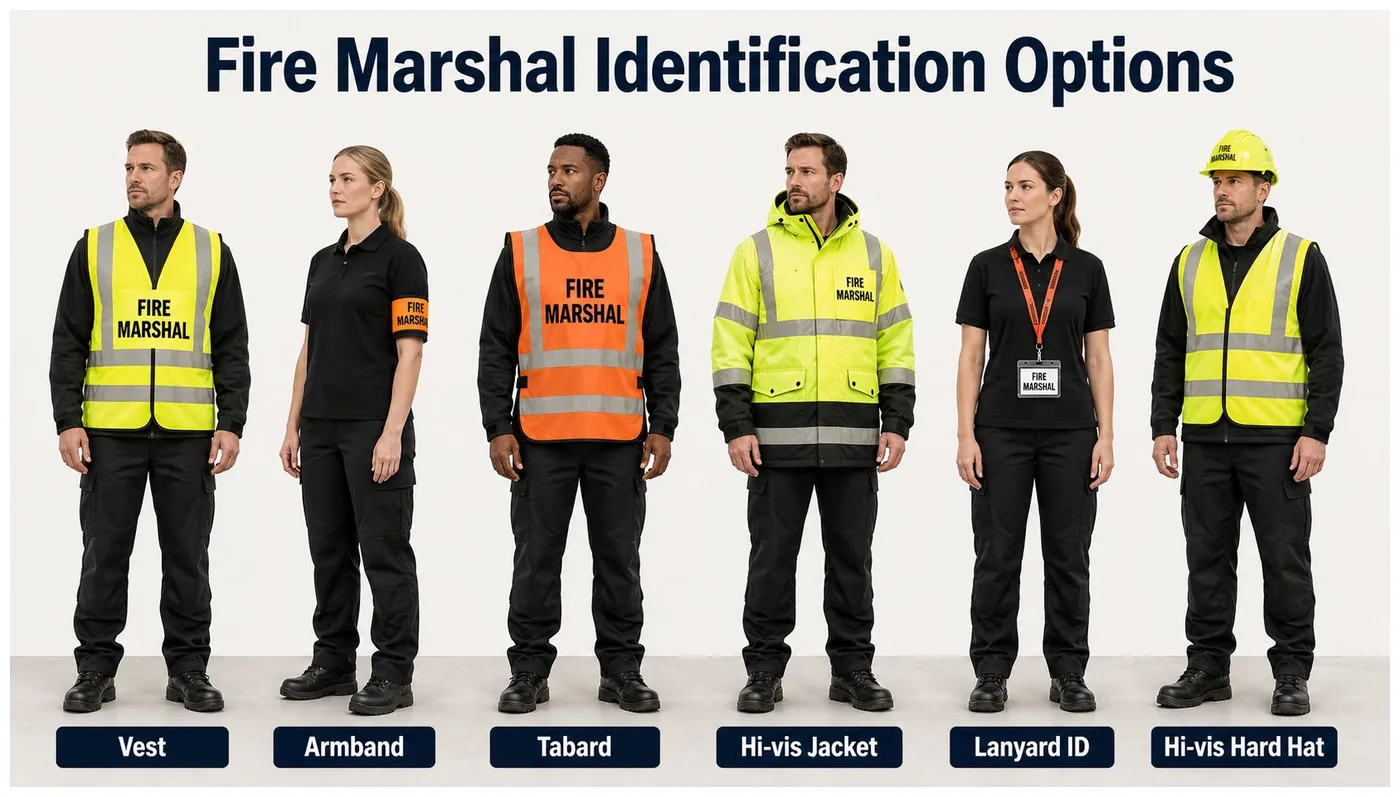
Choose identification suitable for the premises and emergency plan. A labelled vest can help people recognise a marshal, but there is no universal requirement for every marshal to wear EN ISO 20471 Class 2 clothing. Any protective clothing requirement depends on the work risks.
There’s no statutory colour for fire marshal hi-vis in the UK. Yellow and orange dominate by convention; some workplaces use red to signal seniority. Whatever the colour, the print on the back should clearly say “Fire Marshal” or “Fire Warden”.
Beyond the vest, marshals typically have a clipboard and pen for the roll call, a copy of the sweep route plan, and on a larger or multi-storey site some kind of two-way radio or messaging app. We’ve gone into the full kit on the equipment and identification section.
Common questions
Can anyone be a fire marshal?
In principle, yes — the law only says the person needs to be competent for the duties they’re given. In practice, you want someone who’s calm under pressure, attentive to detail, and present in the workplace often enough to actually do the job. Floating staff who are rarely on-site aren’t a great choice.
Do fire marshals get paid extra?
There’s no legal requirement to. Some employers offer a small honorarium or recognise the role through progression frameworks; many treat it as part of normal duties. Whatever the policy, be clear with whoever takes the role about expectations before they accept.
Is fire marshal training mandatory?
Article 21 of the Fire Safety Order expressly requires adequate employee fire-safety training, including at recruitment and when exposed to new or increased risks. Nominated duties need suitable additional preparation; training should be repeated where appropriate.
How long does fire marshal training take?
Duration depends on the provider, content and practical elements. The law requires adequate training for the duties and risks rather than a fixed number of course hours.
What happens if a fire marshal isn’t on duty when a fire breaks out?
This is exactly why you appoint deputies and plan cover for absences. Your fire safety arrangements should function whether your most experienced marshal is on annual leave or not.
Are fire wardens responsible for the fire risk assessment?
No — that’s the responsible person’s duty under the Fire Safety Order. Marshals support it with on-the-ground observations and feedback, but the formal assessment is done by someone competent to do it (in-house if they’re qualified, or an external assessor).
Can a fire marshal be held legally responsible if something goes wrong?
A marshal’s title does not give legal immunity. The Responsible Person retains their duties, while employees have their own duties under article 23. Liability depends on the facts and the law, not simply whether a certificate was held.
What’s covered in this guide
The hub stays deliberately broad. For depth on any individual area, follow the dedicated pages:
- Fire marshal responsibilities — daily duties, emergency duties, what they’re not responsible for
- Fire marshal vs fire warden — the comparison page in full
- How many fire marshals do you need — ratios, worked examples, cover planning
- Fire marshal certificate renewal — validity periods and refresher timing
- Fire marshal test questions — practice quiz and what the real assessment looks like
- Fire marshal checklist — daily, weekly and emergency procedure
- Fire marshal signs and posters — symbols, visibility and practical examples
If you’d rather skip the reading and book training, our Fire Warden Training course covers everything above. £18 per learner, RoSPA approved and CPD accredited, 60 to 90 minutes online from any device, instant certificate on passing, and free unlimited retakes. The certificate has no formal expiry — we recommend a refresh every three years. Bulk discounts from 10+ delegates onwards (up to 40% off for orders of 500+).
Related guides
- Fire marshal responsibilities: the complete UK duties list
- Fire marshal vs fire warden: what’s the difference?
- How many fire marshals do you need? UK requirements explained
Sources & references
Official guidance checked on 15 October 2026. Requirements vary by UK nation and premises.
- Legislation — Fire Safety Order, including articles 13, 15, 18, 21 and 23
- Government — duties under fire safety legislation
- Government — office and shop fire precautions, checks and training
- Government — evacuation arrangements for disabled people
- Government — employee training and drills
Skip the reading and get your team trained — RoSPA approved and CPD accredited fire warden training, £18 per learner.
View course →
Mark writes about workplace fire safety, fire warden training and accredited online training for Fire Warden Training, part of Online CPD Academy.