
A waking watch is an interim fire-safety patrol used to give warning and support evacuation where a building’s assessed risks require it. It can support a temporary change from “stay put” to simultaneous evacuation; it is not a way of keeping an unsafe stay-put strategy in operation. This guide separates England’s historical waking-watch cost survey from current alarm-funding progress.
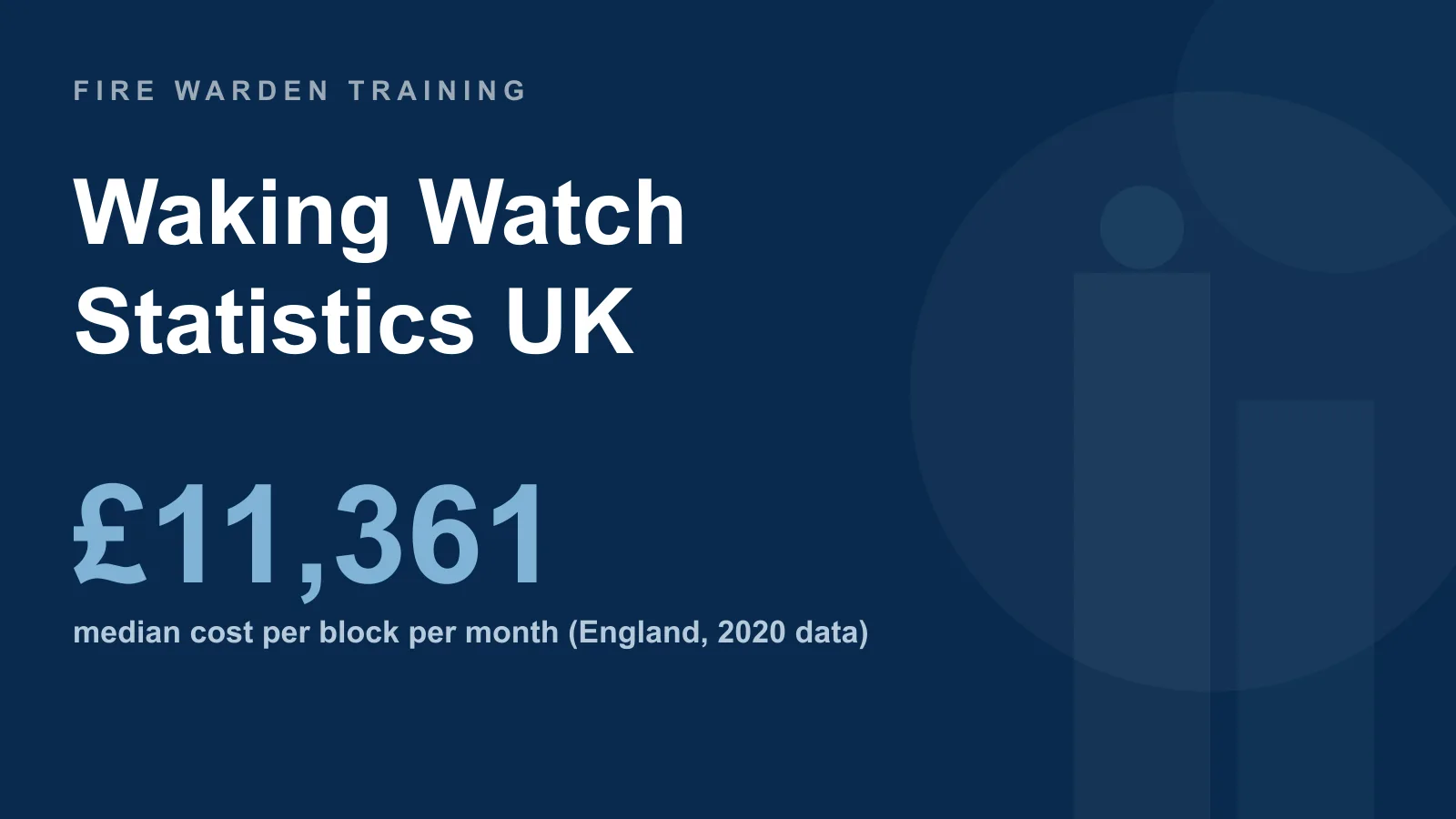
The familiar £11,361 monthly median comes from a non-random sample collected in June–September 2020. The latest funding figures below are for 31 August 2026. Neither dataset provides a current UK-wide count of buildings operating a patrol. Our high-rise fire statistics guide covers the wider remediation programme.
Key facts and figures
- £11,361 median monthly waking-watch cost per building in the England sample collected June–September 2020.
- £17,897 mean monthly cost per building in that England sample; the London mean was £20,443.
- £137 median monthly cost per dwelling in the England sample; the London mean was £499 (2020).
- £13.99 median hourly rate charged per person undertaking waking-watch duties in the 2020 sample — not a measure of staff wages.
- 987 buildings approved across the four alarm-funding schemes in England by 31 August 2026, with £80.2 million approved.
- 799 buildings had alarm installation complete across those schemes at 31 August 2026.
- 151 buildings approved under the Interim Measures Alarm Fund, including 17 with alarm installation complete (31 August 2026).
- 61,400 leasehold dwellings in buildings approved across the four schemes, rounded in the August 2026 tables.
Reviewed on 15 October 2026. The survey costs are historical sample findings, not 2026 market prices. Funding figures are management information for England at 31 August 2026 and distinguish approvals from completed installations.
How much does a waking watch cost per month in the UK?
In the sample collected in June–September 2020, the median monthly cost was £11,361 per building and the mean was £17,897. These are historical England sample averages, not quotations for a particular building or current national prices.
The London sample had a mean monthly building cost of £20,443. For dwellings, the England median was £137 per month and the London mean was £499. Building and dwelling averages use different sample sizes and should not be converted into each other.
The median hourly rate charged per person undertaking waking-watch duties was £13.99, with a mean of £15.88 and a £12–£30 range. The publication does not establish what individual patrol staff were paid.
| Waking-watch cost measure | Median | Mean | Data period |
|---|---|---|---|
| Cost per building per month (England sample) | £11,361 | £17,897 | June–September 2020 |
| Cost per building per month (London sample) | £15,641 | £20,443 | June–September 2020 |
| Cost per dwelling per month (England sample) | £137 | £331 | June–September 2020 |
| Hourly rate charged per person undertaking duties | £13.99 | £15.88 | June–September 2020 |
How reliable is the 2020 cost data?
The per-building averages used 71 buildings, the dwelling averages 65 and the hourly rates 44. The sample was not randomly selected and may not represent England as a whole. Missing information meant different measures used different subsets.
Use the 2020 date whenever quoting these costs. The survey does not establish a present-day price, and the current funding tables describe a selected group of applicants rather than an equivalent repeat survey. A building needs quotations and a risk-based specification to establish its own costs.
How many buildings still have a waking watch?
The August 2026 funding release does not give a national count of live waking watches. It records applications, approvals and alarm-installation progress for specified government schemes in England.
Across the Waking Watch Relief Fund, the 2022 and 2023 Replacement Funds, and the Interim Measures Alarm Fund, 987 buildings had approved funding and 799 had completed alarm installation at 31 August 2026. The approved buildings contained approximately 61,400 leasehold dwellings, with dwelling figures rounded in the release.
Approval is not completion, and neither total measures the buildings currently using a patrol. In particular, Interim Measures Alarm Fund applicants do not have to have an existing waking watch, so its approvals cannot be counted as watches already removed.
What is the Waking Watch Replacement Fund, and is it still open?
The Waking Watch Replacement Fund 2023 closed to new applications on 31 March 2026. Its remaining applications and installation progress continue to appear in the monthly figures. Current applications should be assessed against the separate Interim Measures Alarm Fund guidance.
The table shows approved funding and building progress at 31 August 2026, rather than announced budgets. Approved amounts can be revised as final installation receipts replace provisional maximum awards. The current total across all four schemes is £80.2 million; amounts are rounded.
| Fund / round | Approved funding | Approved buildings / installations complete |
|---|---|---|
| Waking Watch Relief Fund | £27.3 million | 320 approved / 305 complete |
| Waking Watch Replacement Fund 2022 | £2.4 million | 47 approved / 42 complete |
| Waking Watch Replacement Fund 2023 | £40.3 million | 469 approved / 435 complete |
| Interim Measures Alarm Fund | £10.2 million | 151 approved / 17 complete |
| All four schemes — 31 August 2026 | £80.2 million | 987 approved / 799 complete |
What is the Interim Measures Alarm Fund?
The Interim Measures Alarm Fund supports eligible common fire-alarm installations in England. Its guidance, updated on 11 September 2026, requires a residential building or student accommodation with two or more dwellings and technical documentation identifying the need for an interim-measures alarm. Hotels are excluded; residents apply through the appropriate building owner, Responsible Person or authorised representative.
It can fund reasonable installation capital costs, but not waking-watch charges, ongoing maintenance, residual evacuation staff or alarms already installed. The August 2026 tables record £10.2 million approved for 151 buildings, of which 17 had completed installation. An alarm remains an interim measure where underlying defects still require remediation.
Is a common fire alarm cheaper than a waking watch?
The historical cost study found that the cost of one person providing waking-watch duties continuously exceeded the sampled average alarm-installation cost after three to seven months, depending on the hourly rate. This was a comparison using the study’s assumptions, not a guaranteed payback period for every building.
A suitable alarm may reduce reliance on patrols, but installation is not the only cost. Inspection, maintenance and any continuing evacuation-management arrangements need to be considered. Current funding guidance expressly recognises that some buildings may still need on-site personnel after an alarm is fitted.
An alarm does not remove unsafe cladding or automatically make a building suitable for stay put. The fire-risk assessment and competent technical advice must determine the appropriate package of measures and evacuation strategy. Our sister site’s fire alarm statistics guide covers detection data rather than grant funding.
How does this fit the wider cladding picture?
The latest published central estimate for external-wall remediation of residential buildings containing dwellings, 11 metres and over in England, is £15.1 billion, with a £11.8–£22.7 billion range. It uses a March 2025 cost basis and has not been updated for the revised March 2026 building estimates. Alarm-funding totals are a different measure and should not be treated as the total cost of interim safety measures.
At 31 August 2026, 4,724 buildings were in England’s unsafe-cladding remediation portfolio, including 2,571 (54%) with works started or completed. Methodology changes to social-housing data limit comparison with older totals. Our high-rise fire statistics guide explains the stages, height bands and estimate dates.
Frequently asked questions
How much does a waking watch cost per month in the UK?
The historical England sample collected June–September 2020 had a median cost of £11,361 per building per month and a mean of £17,897. It was a non-random sample and does not establish a current UK market price.
How many buildings still have a waking watch?
The funding tables do not give a national live-patrol count. At 31 August 2026, 987 buildings had approved funding across four England alarm schemes, and 799 had completed alarm installation. Some current applicants need not already have a waking watch.
What is the Waking Watch Replacement Fund and is it still open?
The Waking Watch Replacement Fund 2023 closed to new applications on 31 March 2026. The separate Interim Measures Alarm Fund now has current eligibility guidance for England. Approval, installation completion and the removal of any patrol are different stages.
Is a common fire alarm cheaper than a waking watch?
The 2020 study compared the sampled average installation cost with one person undertaking waking-watch duties continuously and found a three-to-seven-month crossover. Actual costs vary; maintenance and any continuing evacuation-management staff must also be considered.
Why does a building need a waking watch at all?
A waking watch can provide warning and evacuation support as an interim response to assessed fire risks, including a temporary change from stay put to simultaneous evacuation. It does not repair building defects, and its design or replacement needs competent risk-based advice.
Where do UK waking watch statistics come from?
Historical sample costs come from MHCLG’s Building Safety Programme survey. Current approvals and completed installations come from the August 2026 Building Safety Remediation tables. Homes England publishes current Interim Measures Alarm Fund eligibility guidance.
If you help run a block, an office or any multi-occupied building, the waking watch story is a reminder of what competent people on the ground are for: interim measures only work when someone knows the evacuation plan and can act on it. Our Fire Warden Training course covers evacuation procedure, sweeps, assembly-point management and helping vulnerable occupants — £18 per learner, RoSPA approved and CPD accredited, 60 to 90 minutes online with an instant certificate on passing, and bulk discounts from 10 delegates upwards.
Related guides
- High-Rise Fire Statistics UK: Fires in Tall Buildings & Cladding Remediation Data
- Fire Evacuation Statistics UK: Rescues, Drills & Evacuation Behaviour Data
- Fire and Rescue Service Statistics UK
- Fire Door Statistics UK: Failure Rates, Inspections & Compliance Data
- Fire marshal responsibilities: the complete UK duties list
Sources & references
- MHCLG — Waking Watch costs: June–September 2020 survey, methods and alarm comparison
- MHCLG — August 2026 management-information tables: WWRF_1–5 and notes 92, 98 and 99
- Homes England — Interim Measures Alarm Fund guidance, updated 11 September 2026
- MHCLG — Building Safety Remediation, August 2026: portfolio and dated cost estimates
Interim fire measures only work with trained people on the ground — get certified with accredited, workplace-ready training.
Explore the Fire Warden Training course →
Mark writes about workplace health & safety, fire safety and accredited online training for Fire Warden Training, part of Online CPD Academy.