
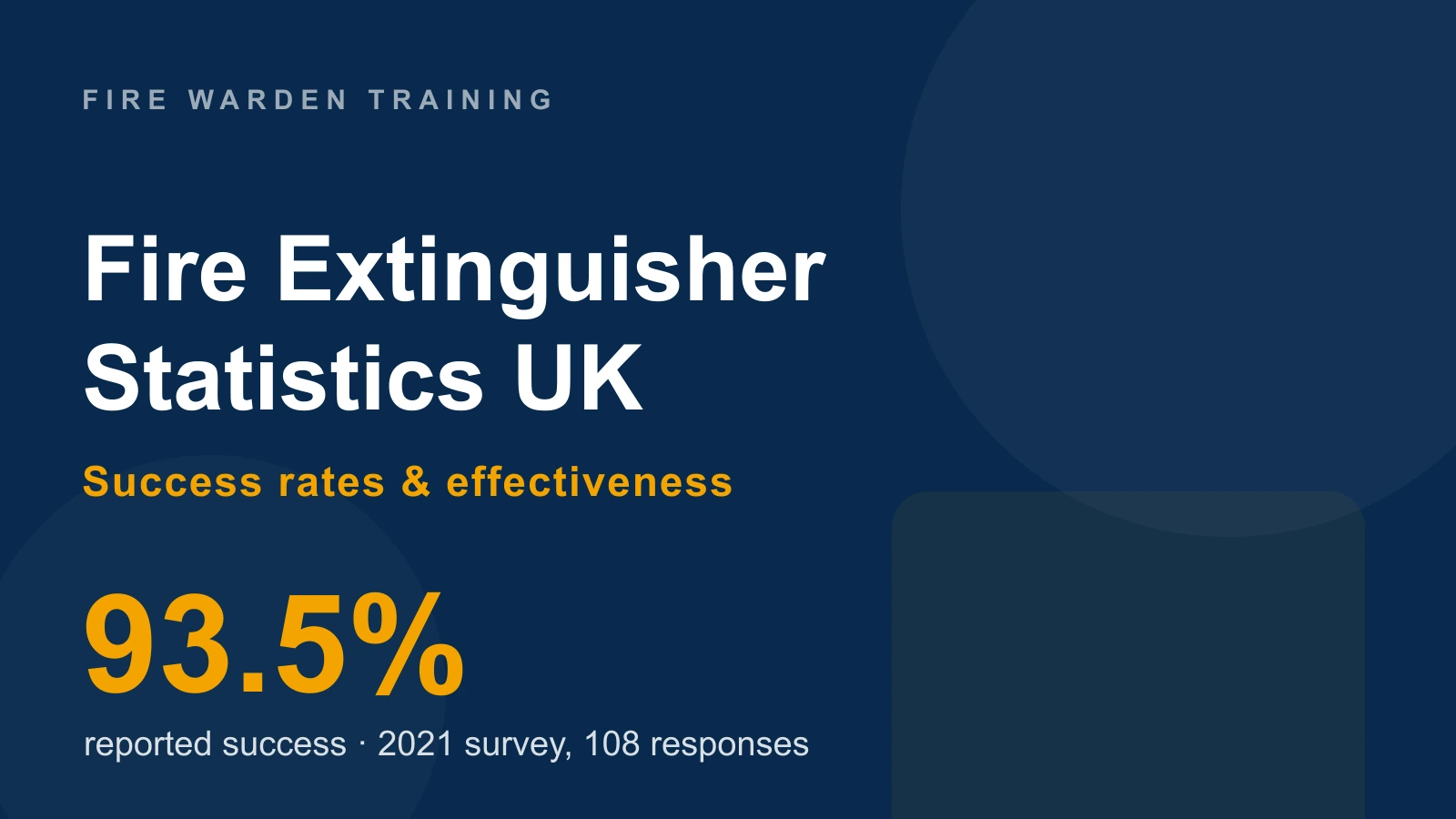
The original presentation of the 2021 survey by four UK fire trade associations reports that 93.5% of surveyed fires were put out with portable extinguishers. There were only 108 responses, gathered through extinguisher technicians from users of discharged equipment. This is a dated industry sample, not a current national success rate. This page separates it from official England fire statistics.
The figures below describe the survey’s reported outcomes, training and fire-service calls, alongside the Home Office’s separate analysis of attended fires. Dates, sample limitations and differences between sources matter: a survey result does not establish that attempting to fight a fire is safe in an individual situation.
Key facts and figures
- 93.5% of surveyed fires were put out in the 2021 industry survey; its summary rounds this to 93%.
- 52% of surveyed users had received extinguisher training; this does not establish whether the others had used one before.
- 7% of England’s 68,757 attended primary fires in 2019/20 involved public extinguisher use: 4,828 incidents.
- 27% of survey cases involved a call to the fire service, according to the original 2022 presentation; a later written summary gives a conflicting 73%.
- 108 responses were collected in 2021. The survey is not a representative sample of every UK fire.
- 93.5% of surveyed cases involved the correct extinguisher type, according to the original presentation.
- 25% of surveyed fires in 2021 were described as electrical; this was 19% in the separate 2008 survey.
- 170,597 fires were attended in England in 2025/26, including 66,383 primary fires. These official totals do not update the 2021 survey.
Checked on 15 October 2026. The extinguisher survey covers 2021 and was presented in February 2022; the official extinguisher-use extract covers 2019/20. England incident totals cover 2025/26. The original survey charts are used where a later written account conflicts with them.
How effective are fire extinguishers in the UK?
The original 2021 survey charts report 93.5% successful extinguishment; the presentation’s headline and subsequent FIA article round this to 93%. The associations reported 80% in their 2003 survey, but the separate samples do not establish a like-for-like national trend.
The FIA, IFEDA, British Fire Consortium and UK Fire Association gathered 108 responses through technicians whose clients had used extinguishers. Participation depended on a used extinguisher being encountered and a response being supplied. The result describes those reported cases; it cannot establish effectiveness across all fires, all users or all premises.
The FIA article also repeats modelled estimates of 1,629 injuries prevented and 24 lives saved from its 2003 work. These are historical estimates, not observed deaths or injuries avoided in 2021 and not current annual government statistics.
What percentage of fires are put out with a fire extinguisher?
Home Office analysis recorded public extinguisher use at 4,828 of 68,757 primary fires attended in England in 2019/20: 7%. This measures use at incidents attended by fire and rescue services; it is not a count of fires successfully extinguished by the public.
The 7% and 93.5% figures have different denominators. The first covers attended primary fires in England in one financial year. The second is the reported outcome in a small industry sample collected in 2021. They cannot be combined to calculate the proportion of all UK fires successfully put out with an extinguisher.
The Home Office publication is a one-off analysis rather than an annually refreshed series. Fires that never came to the service’s attention are outside its coverage. Later overall fire totals do not make this 2019/20 extinguisher-use percentage current.
| Measure | Figure | Data period | Source type |
|---|---|---|---|
| Surveyed fires put out | 93.5% | 2021 | Industry survey; 108 responses |
| Surveyed users with training | 52% | 2021 | Industry survey |
| Correct extinguisher selected | 93.5% | 2021 | Original survey chart |
| Fire service called | 27% | 2021 | Original chart; later text conflicts |
| Attended primary fires involving public extinguisher use (England) | 7% (4,828 / 68,757) | 2019/20 | Official one-off IRS analysis |
| Survey responses collected | 108 | 2021 | Technician-mediated industry sample |
Do you need training to use a fire extinguisher?
Training was reported for 52% of users in the 2021 sample. An absence of reported training does not mean first-time use, and this selected group cannot establish the training rate among all workers, fire wardens or UK residents.
The survey reports training and outcomes, but does not demonstrate the causal effect of training. It also cannot establish the risks of attempts outside the sample. Choosing appropriate equipment and deciding whether any attempt is safe require more than interpreting an overall success percentage.
In England and Wales, Article 13 of the Fire Safety Order requires appropriate firefighting measures and, where necessary, competent people to implement them with adequate training. This does not require every fire warden to fight fires. Follow the premises plan, raise the alarm and prioritise escape; never delay evacuation or re-enter to collect an extinguisher.
How often is the fire service still called after an extinguisher is used?
The original survey presentation shows 27% “yes” and 73% “no” for whether the fire service was called. Its final summary also says 27%. The later FIA webpage reverses this in its prose, so this page uses the original chart and makes the disagreement explicit.
The survey records whether a call was made, not a verified attendance rate or evidence that not calling was safe. Follow the fire emergency plan and notify the fire service promptly. A fire appearing to go out does not rule out hidden spread or re-ignition.
What types of fire are tackled with extinguishers?
The FIA summary describes electrical fires as 25% of the 2021 sample, compared with 19% in 2008. Oil or flammable-liquid fires were 8%, compared with 26%. These are shares of separate survey samples, not national fire frequencies or proof of changes in how buildings are used.
The 2021 presentation identifies electricity, hot work and battery-operated equipment as prominent reported causes. Vehicle fires accounted for 18% in the written summary, compared with 22% in 2008. Small samples and differences in reporting limit conclusions about trends.
Equipment should match the actual hazards identified in a premises risk assessment. These sample percentages do not determine what extinguisher a particular workplace needs. The wider causes and detection context is covered in our sister site’s fire safety awareness training.
What do fire extinguishers save the UK economy?
The FIA’s 2022 article repeats estimates from the 2003 study of more than £500 million a year in economic savings and £5.1 million in fire-service savings. These are historical industry estimates, not current measured totals. The previously quoted £840 million and £8.6 million figures are not presented here as verified 2021 estimates.
No updated national economic total is established by the 108-response survey presentation. Monetary estimates depend on assumptions about avoided damage, escalation and response costs; they should not be treated as audited savings or evidence that an individual should attempt to fight a fire.
Should homes have fire extinguishers too?
An IFEDA-funded report published in March 2021 examined extinguishers in dwellings. BAFE welcomed further discussion and their provision where justified by a competent risk assessment, while prioritising life safety. This is an industry position, not a universal legal requirement for homes.
CROSS’s expert panel in February 2025 called for more independent research into domestic benefits and risks. It warned against residents leaving a flat to fetch an extinguisher and then returning to the fire. Follow the building’s emergency arrangements and relevant fire-service guidance; the business survey is not proof of equivalent results in homes.
How does this fit the wider UK fire picture?
England’s fire and rescue services attended 170,597 fires in 2025/26, including 66,383 primary fires; 254 fire-related fatalities were recorded. These MHCLG totals describe the wider workload and harm, not extinguisher effectiveness.
Use each dataset for the question it can answer: the official extract records use at attended primary fires, while the industry survey describes a small group of reported extinguisher cases. For wider workload, see our fire and rescue service statistics. Neither dataset replaces a premises-specific fire risk assessment.
Frequently asked questions
How effective are fire extinguishers in the UK?
The original presentation reports 93.5% successful extinguishment in the 2021 industry survey, based on 108 responses collected through extinguisher technicians. This is a selected, dated sample rather than a current UK-wide success rate.
What percentage of fires are put out with a fire extinguisher?
Official analysis found public extinguisher use at 7% of attended primary fires in England in 2019/20: 4,828 of 68,757. It measures use, not successful extinguishment. The separate 2021 survey’s outcome percentage has a different denominator.
Do you need training to use a fire extinguisher?
In England and Wales, Article 13 of the Fire Safety Order requires appropriate firefighting measures and, where necessary, competent nominated people with adequate training. Not every warden must fight fires. In the 2021 survey, 52% of users reported training.
How often do fire and rescue services still attend after an extinguisher is used?
The original 2021 survey chart says the fire service was called in 27% of cases. A later written summary incorrectly conflicts with that chart at 73%. The survey does not establish an attendance rate or whether a decision not to call was safe.
Where do UK fire extinguisher statistics come from?
The joint industry survey supplies the dated outcome and training figures. Home Office analysis supplies the separate 2019/20 England usage figure, and MHCLG supplies 2025/26 overall incident totals. The original survey presentation is linked below.
The 2021 sample highlights the importance of understanding both equipment and its limits. Our Fire Warden Training course covers extinguisher types, the choose-and-use decision, and when to fight a fire versus evacuate — £18 per learner, RoSPA approved and CPD accredited, 60 to 90 minutes online, with an instant certificate on passing and bulk discounts from 10 delegates.
Related guides
- Fire Evacuation Statistics UK: Rescues, Drills & Evacuation Behaviour Data
- Fire and Rescue Service Statistics UK: Workload & Response Times
- High-Rise Fire Statistics UK: Fires in Tall Buildings & Cladding Remediation Data
- Fire marshal: a complete UK guide to the role, duties and training
- Fire marshal checklist: daily, weekly and emergency procedure
Sources & references
- FIA / IFEDA / BFC / UKFA — Original 2021 survey presentation, February 2022 (108 responses; 27% fire-service calls)
- FIA — 2022 survey summary and historical 2003 estimates (callout text conflicts with original chart)
- Home Office — Extinguisher use at attended primary fires, England 2019/20
- MHCLG — Fire and rescue incident statistics, England 2025/26
- BAFE — Discussion of the IFEDA-funded domestic-extinguisher report, March 2021
- CROSS — Expert panel on residential extinguishers, February 2025
- Legislation.gov.uk — Fire Safety Order, Article 13
Only attempt extinguisher use when it is safe and within your training and the premises plan. Get certified with accredited, workplace-ready training.
Explore the Fire Warden Training course →
Mark writes about workplace health & safety, fire safety and accredited online training for Fire Warden Training, part of Online CPD Academy.