
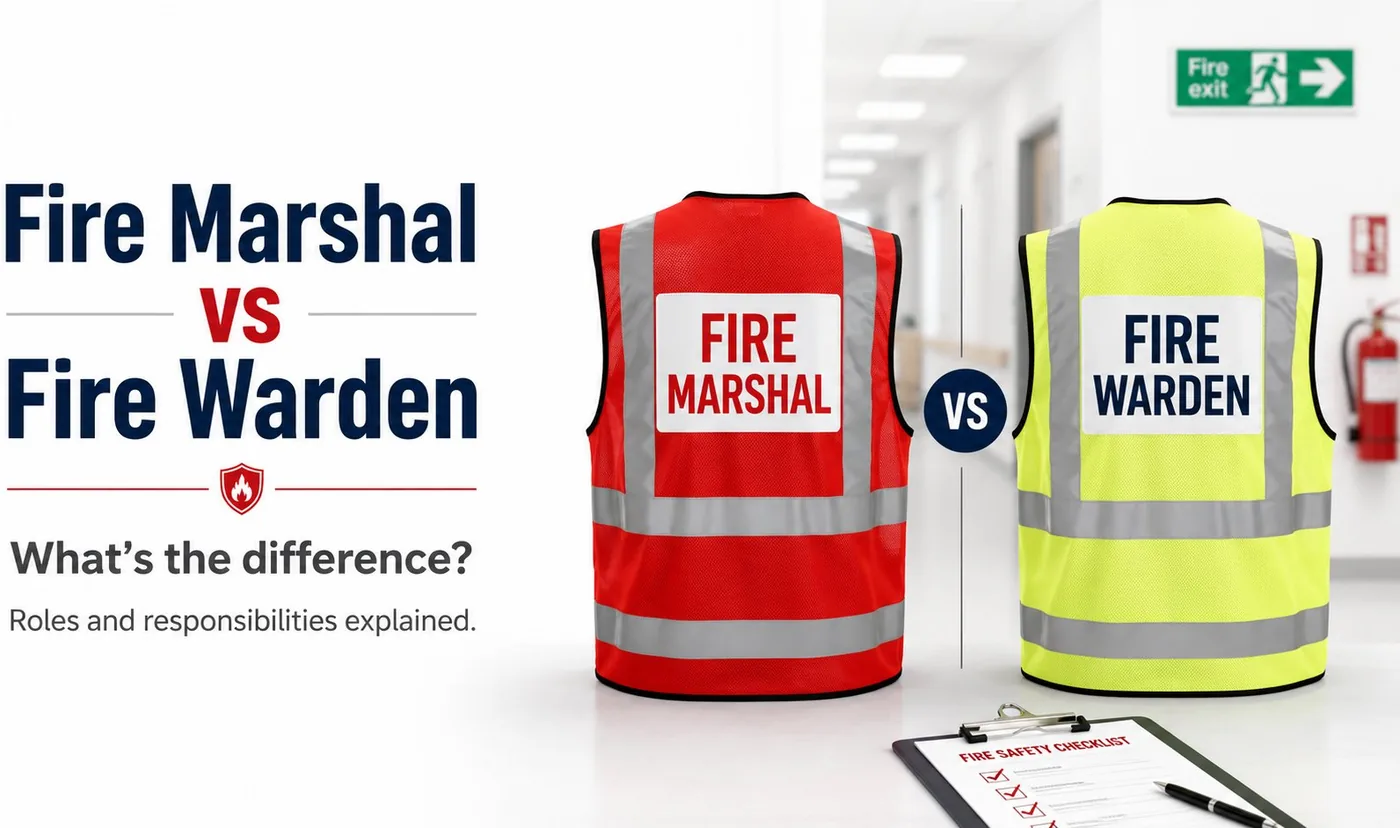
UK workplaces often use fire marshal and fire warden for similar support roles. The titles do not create a legal hierarchy, but employers may assign different duties, so the local emergency plan matters.
Choose clear titles and enough competent people for the assessed duties. In England and Wales those arrangements sit within the Fire Safety Order; Scotland and Northern Ireland have separate fire-safety legislation.
That said, there are some good reasons both terms exist, and there are situations where larger organisations deliberately use them to mean different things internally. Worth understanding both.
What UK law says about the two terms
The Fire Safety Order applies in England and Wales and does not prescribe either title. It requires appropriate emergency arrangements and sufficient competent assistance for the relevant measures.
That's it. Whoever those competent people are, whatever title they're given, the law treats them the same. A workplace can call them fire marshals, fire wardens, fire safety officers, fire monitors, evacuation coordinators — the legal duty doesn't change.
Neither title alone proves competence or identifies an identical syllabus. Check the actual duties, training content and site-specific preparation rather than relying on the course name.
Why both terms exist
Both names are used in workplace emergency planning. Their history does not determine a person’s current duties or competence.
Naming conventions differ between organisations and sectors. The local plan should state what each person is expected to do.
Moving to another workplace can change the hazards, routes and assistance arrangements. A previously trained marshal or warden still needs the new site’s instruction and any additional preparation required by the role.
When workplaces deliberately split the two roles
There's one situation where the distinction does matter in practice — when a larger or more complex organisation chooses to split the duties and gives each split a different title. This isn't legally required and most workplaces don't bother, but in bigger sites it can be a useful organisational tool.
One possible division, which must be defined locally, is:
- Wardens check assigned accessible areas while leaving, help people under the agreed plan and report from safety. They must not remain inside to be last out or enter smoke.
- Fire marshals are responsible for managing things at the assembly point. They take the roll call, account for visitors and contractors, liaise with the fire and rescue service when they arrive, and make sure nobody re-enters the building until it's safe. They also account for the fire wardens themselves once they've completed their sweeps.
At a complex site, define safe zones and the people needed for simultaneous duties, communication and assistance. Employee totals and the number of exits alone cannot establish a staffing number.
In smaller workplaces this kind of split adds complexity without adding value. A single trained role, called whatever the workplace prefers, does both halves of the job.
UK vs US — where the confusion comes from
In the United States, the title can refer to a public fire-prevention, inspection or investigation official. Powers vary by jurisdiction; that is a different use of the term from the UK workplace role described here.
UK fire marshals are nothing like this. They're civilians — regular employees in a regular workplace, with no enforcement powers, no uniform, and no investigatory function. They're trained to support fire safety in their own organisation, not to inspect anyone else's.
If you've come across articles describing fire marshals as fire investigators or enforcement officers, those are almost always written from a US perspective. The UK role is purely a workplace fire safety function.
Which one does your business need?
The honest answer is that the question is wrong. You don't need a fire marshal or a fire warden — you need an appropriate number of trained, competent people to manage fire safety on your premises, and you can give them either title.
The right place to start is the fire risk assessment. That's the document that determines how many trained people you need, what their specific duties should be, and whether the role is straightforward enough for one title or complex enough to benefit from splitting. We've covered the question of numbers in detail on the how many fire marshals do you need page.
Whatever title you settle on, use it consistently. A workplace that calls the role "fire warden" in its policy document, "fire marshal" on the high-vis vests, and "fire safety officer" in its training records is making things harder than they need to be — and confusing for staff trying to remember who to listen to during a real evacuation.
Common questions
Is fire warden the older term?
Usage varies, and this guide does not rely on an established historical ranking of the titles. Neither name is legally superior; use the workplace’s defined terminology.
Can one person do both roles?
One person can carry out compatible duties where the assessment shows that they can be completed safely. Other premises need separate people for simultaneous tasks; neither title decides that.
Do I need separate fire marshal and fire warden training?
The name alone does not decide training needs. Compare the assigned duties, syllabus and practical preparation; additional instruction may be needed where the roles differ.
Does the difference matter for compliance with the Fire Safety Order?
No. The Order doesn't reference either title. What it requires is that competent people are appointed to carry out the necessary duties — the title you give them is a workplace decision.
My workplace uses both titles for different roles. Is that allowed?
Yes. Define each role clearly, provide training suited to its actual duties and coordinate the arrangements. Different duties may require different training.
If you're at the stage of arranging training, our Fire Warden Training course covers the role under either title — the same training, the same certificate, recognised whether your workplace prefers "fire marshal" or "fire warden" on its paperwork. £18 per learner, RoSPA approved and CPD accredited, 60 to 90 minutes online, instant certificate on completion, and bulk pricing for groups.
For more on what the role actually involves day-to-day, see the fire marshal responsibilities page or the main fire marshal guide.
Related guides
- Fire marshal signs and posters: symbols, visibility and practical examples
- Fire marshal checklist: daily, weekly and emergency procedure
- Equipment and identification: fire marshal guide
Sources & references
Official guidance checked on 15 October 2026. Requirements vary by UK nation and premises.
- Legislation — Fire Safety Order, including articles 13, 15, 18, 21 and 23
- Government — duties under fire safety legislation
- Government — office and shop fire precautions, checks and training
Make sure your appointed fire wardens are trained to carry out their duties under the Fire Safety Order.
View course →
Mark writes about workplace fire safety, fire warden training and accredited online training for Fire Warden Training, part of Online CPD Academy.