
Fire-safety signs must be clear, appropriate and visible for the assessed risks. British and international standards help with symbols, selection and positioning, but the applicable law and the premises’ escape arrangements determine what is needed.
This page covers the legal framework, the five categories of fire safety sign and what each looks like, where signs need to be placed, and the specific signage workplaces use to identify their fire marshals. We've also included some free printable templates at the end.

The legal framework
The main provisions discussed here have different geographical scopes:
The Fire Safety Order applies in England and Wales and includes requirements for signs identifying firefighting equipment and emergency routes and exits where necessary. Scotland and Northern Ireland have separate fire-safety legislation.
The Health and Safety (Safety Signs and Signals) Regulations 1996 apply in Great Britain. Their schedules specify safety-sign features; Northern Ireland has separate corresponding regulations. HSE’s L64 explains the requirements and use of recognised pictograms.
Standards can help implement the duties, but displaying a standards number alone does not establish that a sign is appropriate, correctly located or visible.
BS 5499 vs BS EN ISO 7010 — what's the difference?
This is one of the genuinely confusing questions in UK fire safety, so it's worth unpacking properly.
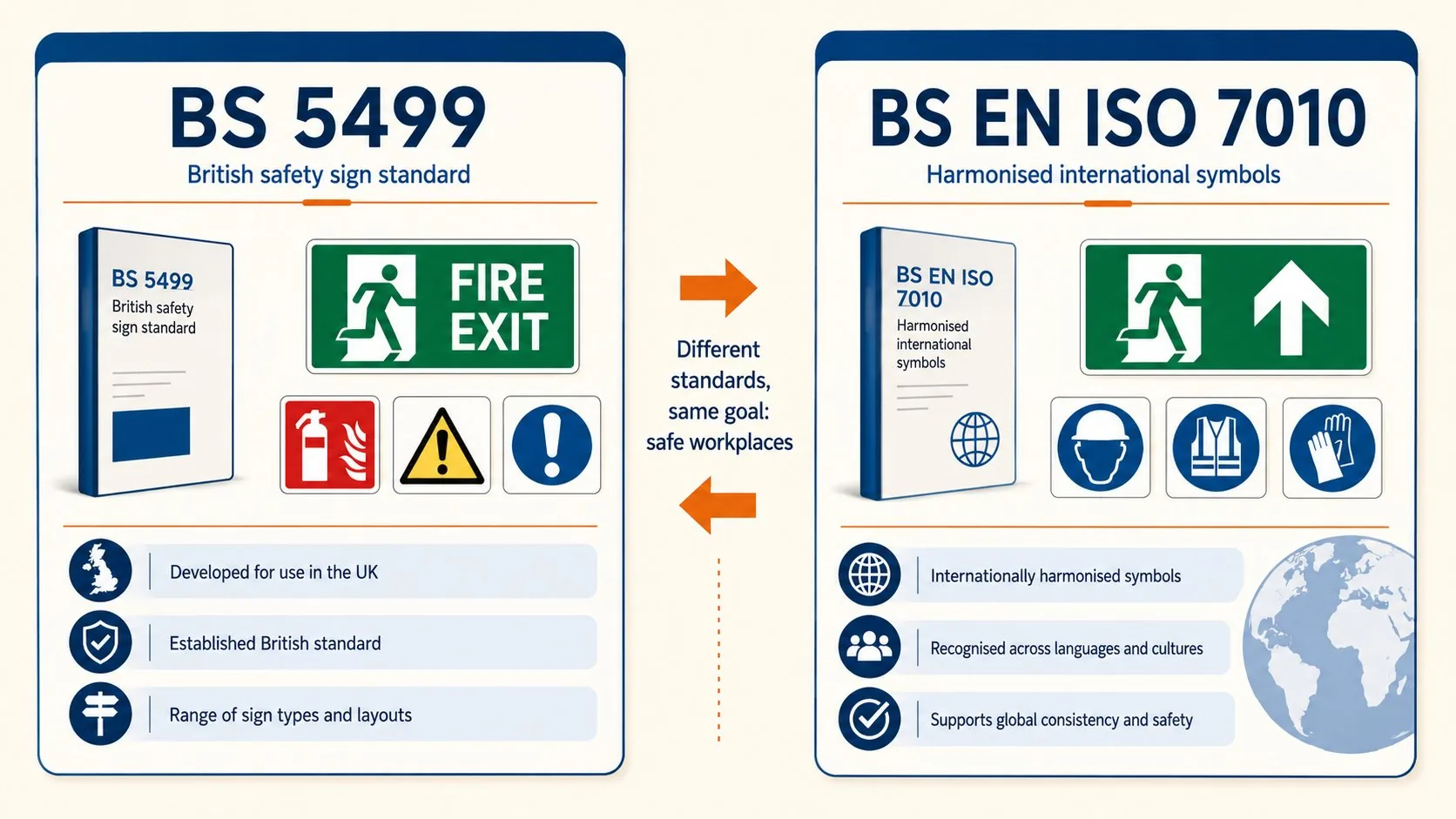
BS 5499 is a series covering aspects of safety signs, including selection and escape-route signing. BS EN ISO 7010 provides registered safety symbols, while ISO 3864 addresses design principles. Use the relevant current part rather than treating the series as one interchangeable specification.
BS EN ISO 7010 standardises registered safety symbols. Its purpose is consistent recognition; it does not mean every country or existing building uses identical signs.
Older signs do not automatically become unlawful when a standard changes. Check whether the actual signs meet the applicable requirements and remain clear and consistent for occupants.
In practice:
- For new signs, specify suitable recognised pictograms, dimensions and performance for their intended use
- Assess existing signs for suitability, legibility and consistency; age or a standards label alone does not determine compliance
- Avoid confusing or inconsistent directions and symbols; each sign should clearly indicate the intended route or equipment
Ask the supplier which current standards and performance specifications the product meets, and confirm it suits the location, lighting and viewing distance.
The five categories of fire safety sign
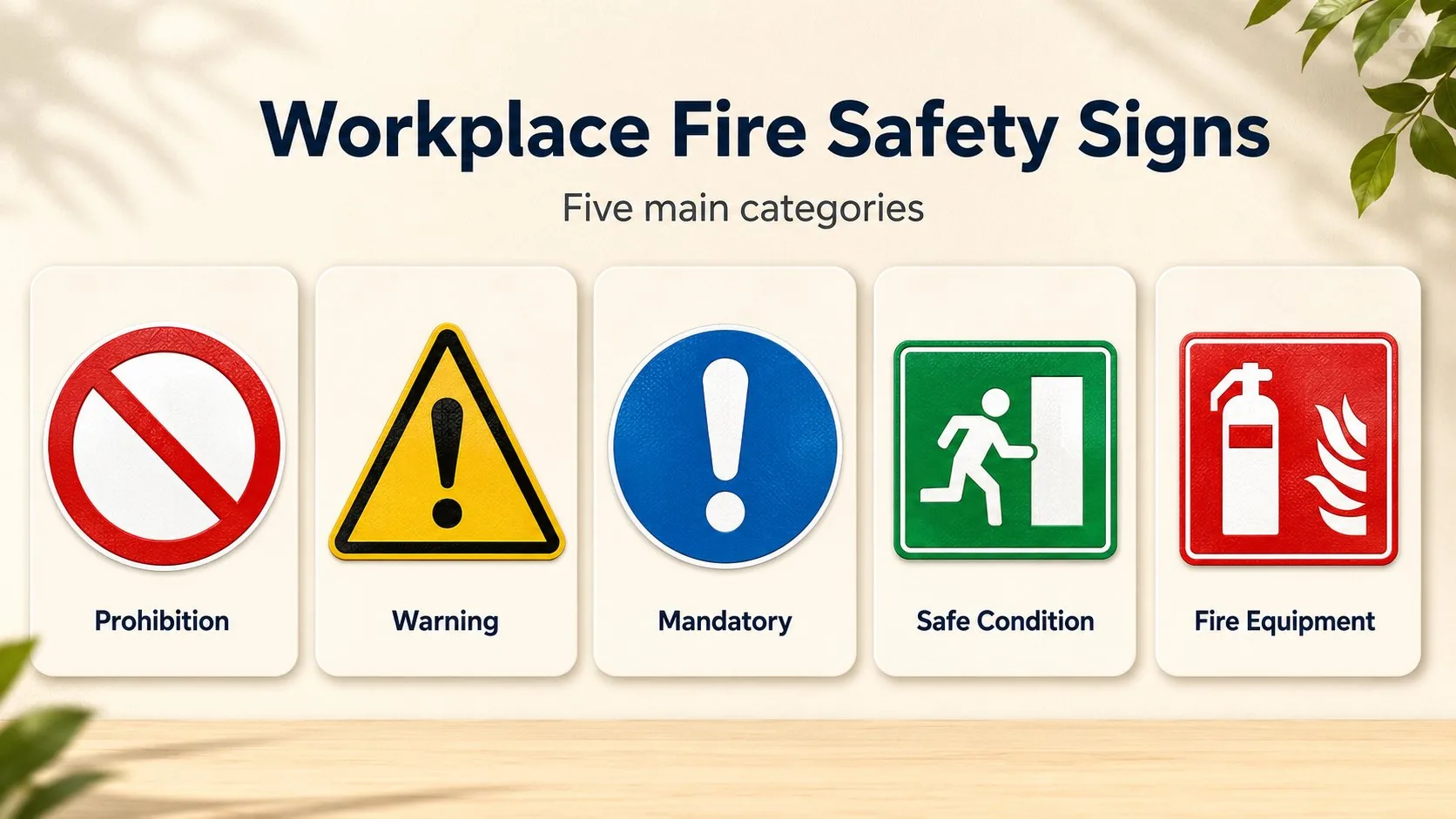
The safety-sign conventions below use distinct shapes and colours. The details of the symbol, contrast and visibility also matter; colour alone does not establish compliance.
Prohibition signs (red circle, diagonal bar)
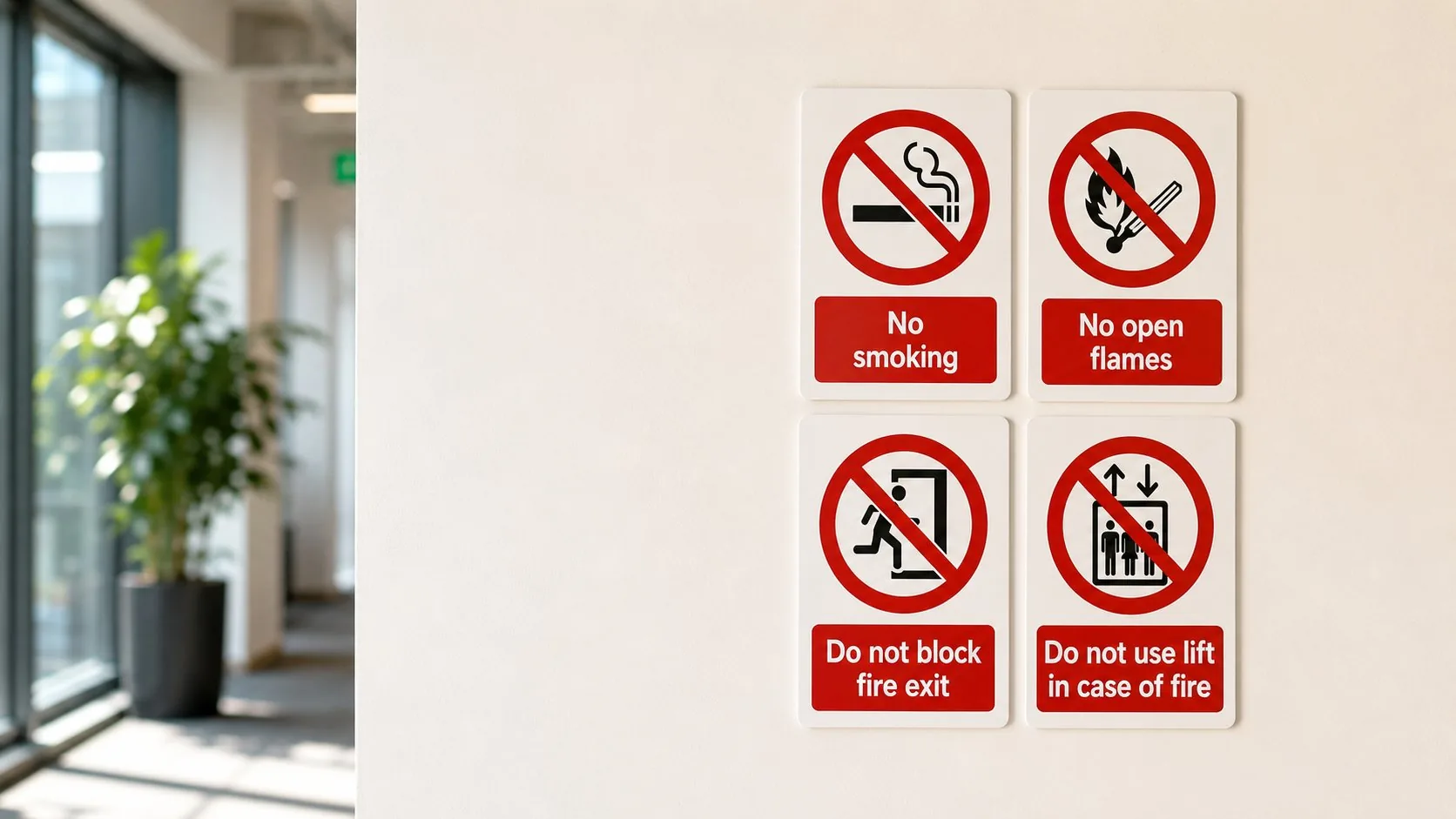
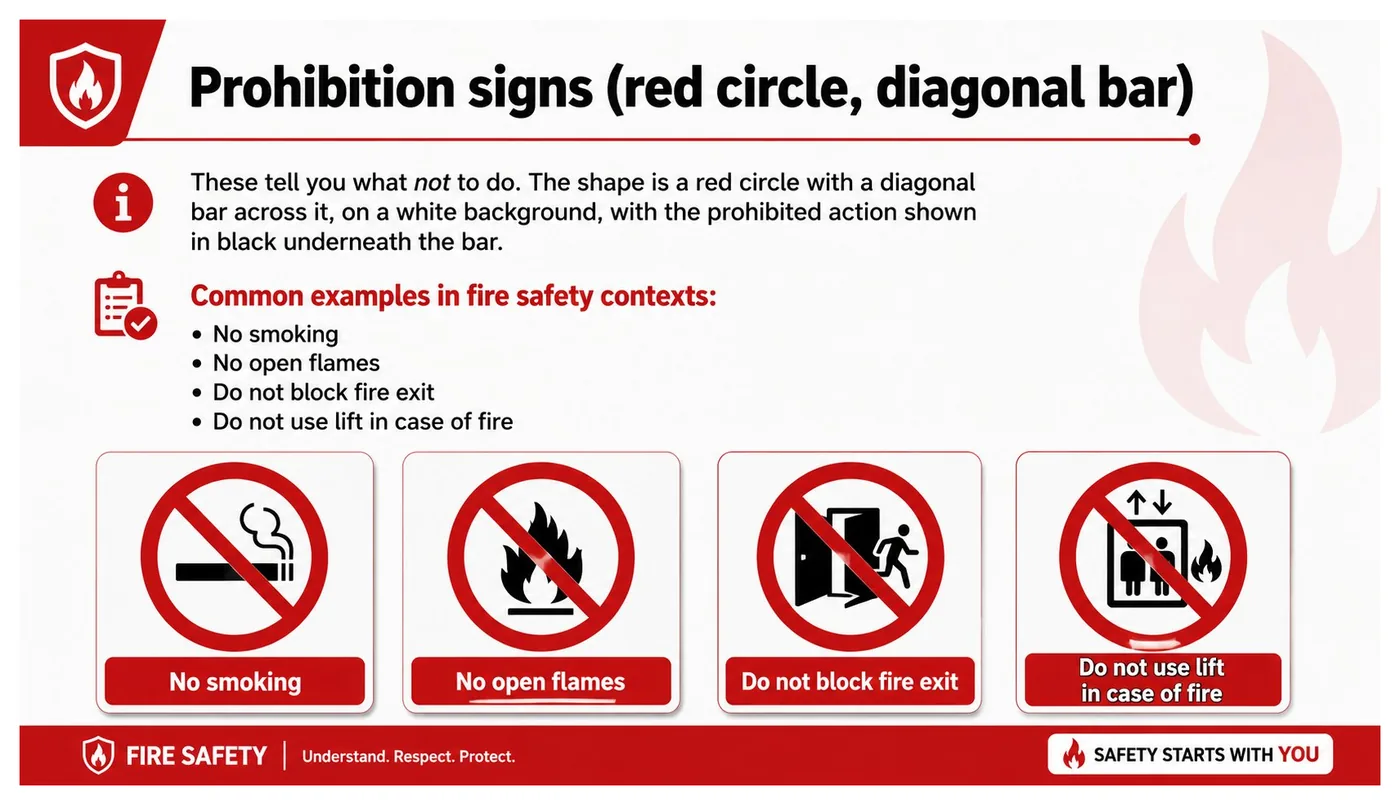
These tell you what not to do. The shape is a red circle with a diagonal bar across it, on a white background, with the prohibited action shown in black underneath the bar.
Common examples in fire safety contexts:
- No smoking
- No open flames
- Do not block fire exit
- Do not use lift in case of fire
Warning signs (yellow triangle)
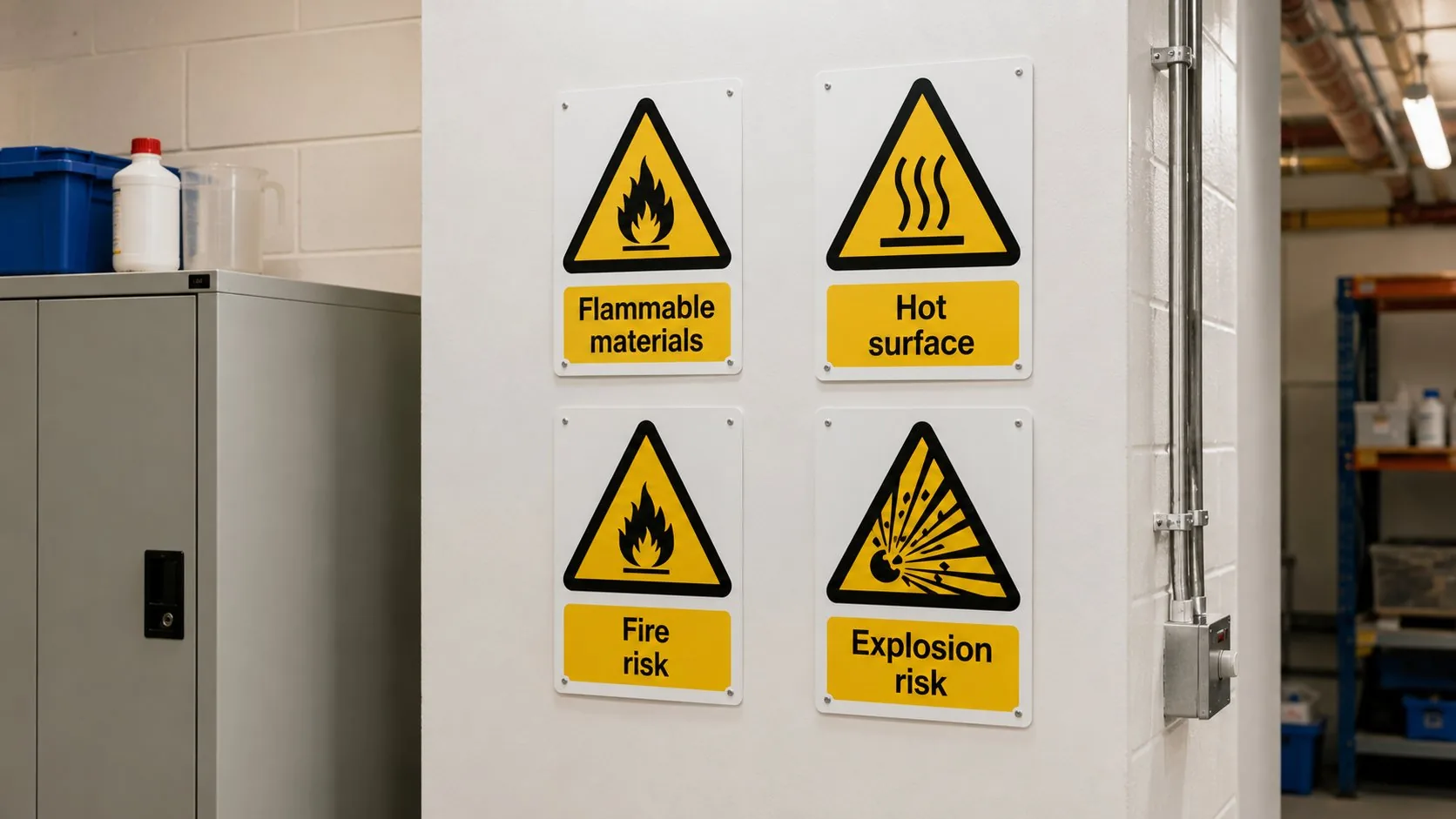
These warn of a hazard or danger. The shape is a yellow triangle with a black border, with the hazard symbol shown in black inside.
Common examples:
- Caution: flammable materials
- Caution: hot surface
- Risk of fire
- Risk of explosion
Mandatory signs (blue circle)

These tell you what you must do. The shape is a solid blue circle with the required action shown in white.
Common examples in fire safety:
- Fire door — keep shut
- Fire door — keep closed
- Fire door — keep locked
- Wear protective equipment
Safe condition signs (green rectangle)
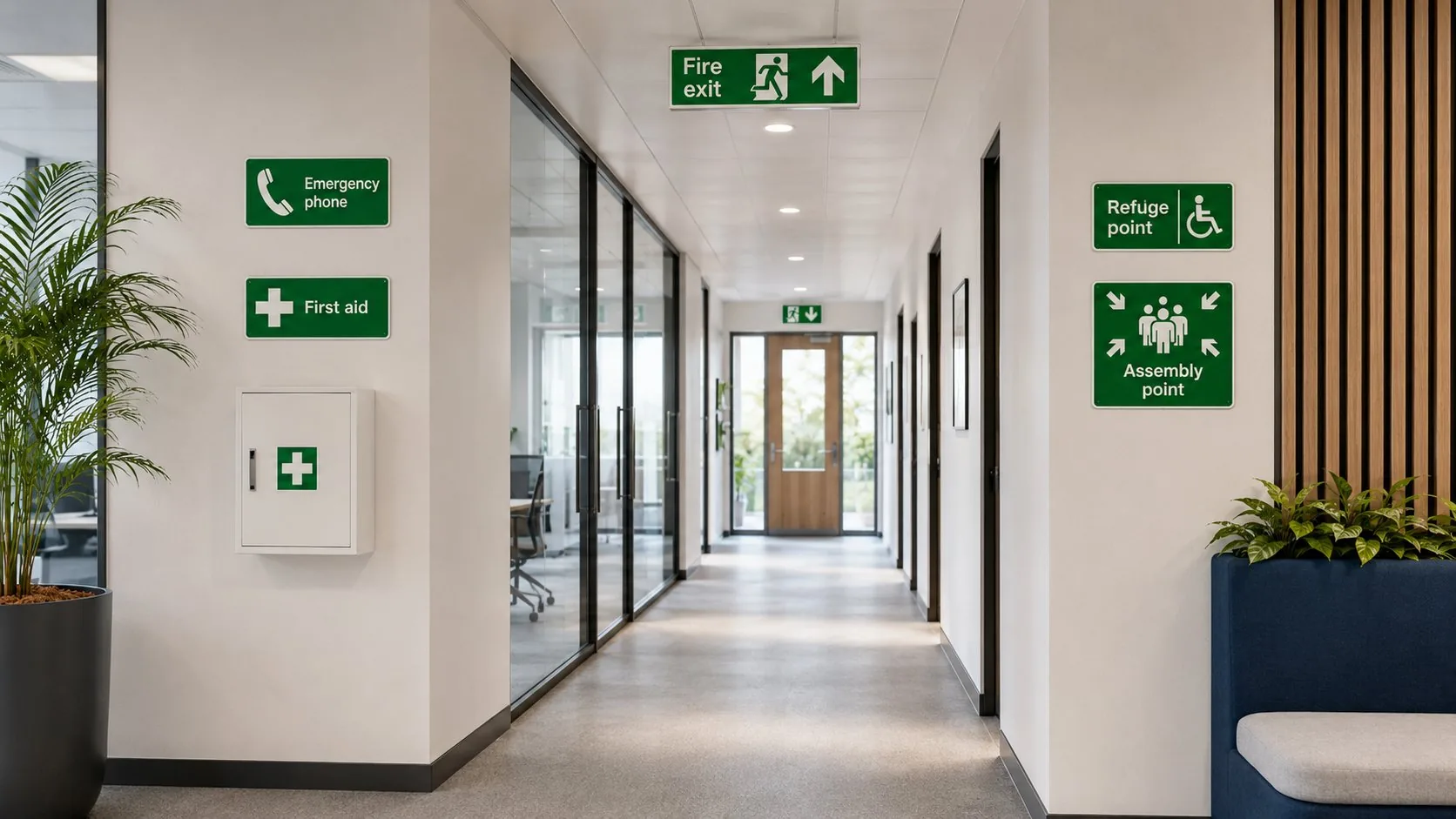
Safe-condition signs use a white pictogram on a green square or rectangle, with supplementary text where useful.
Common examples:
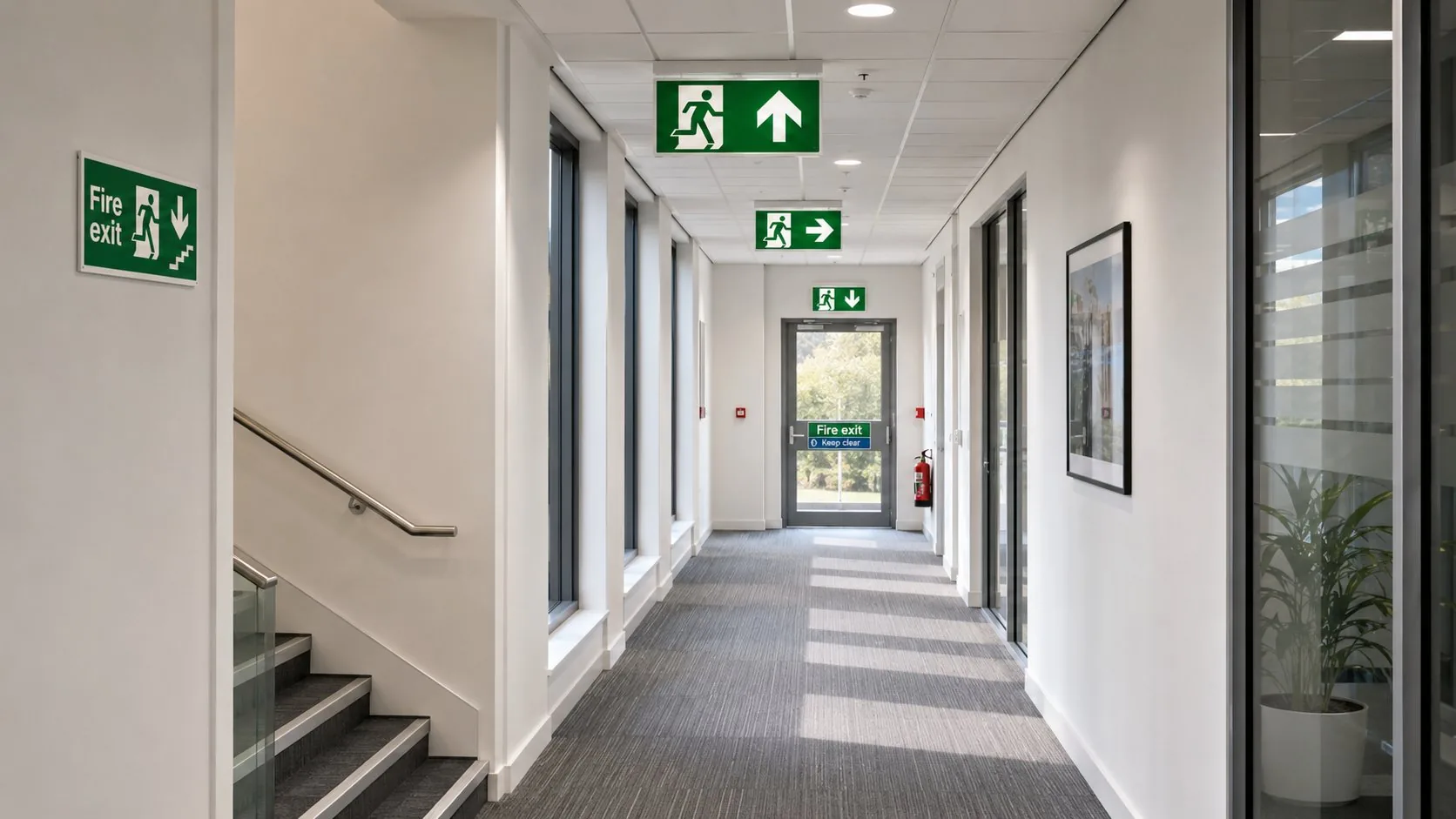
- Fire exit (with the "running man" pictogram and an arrow)
- Assembly point
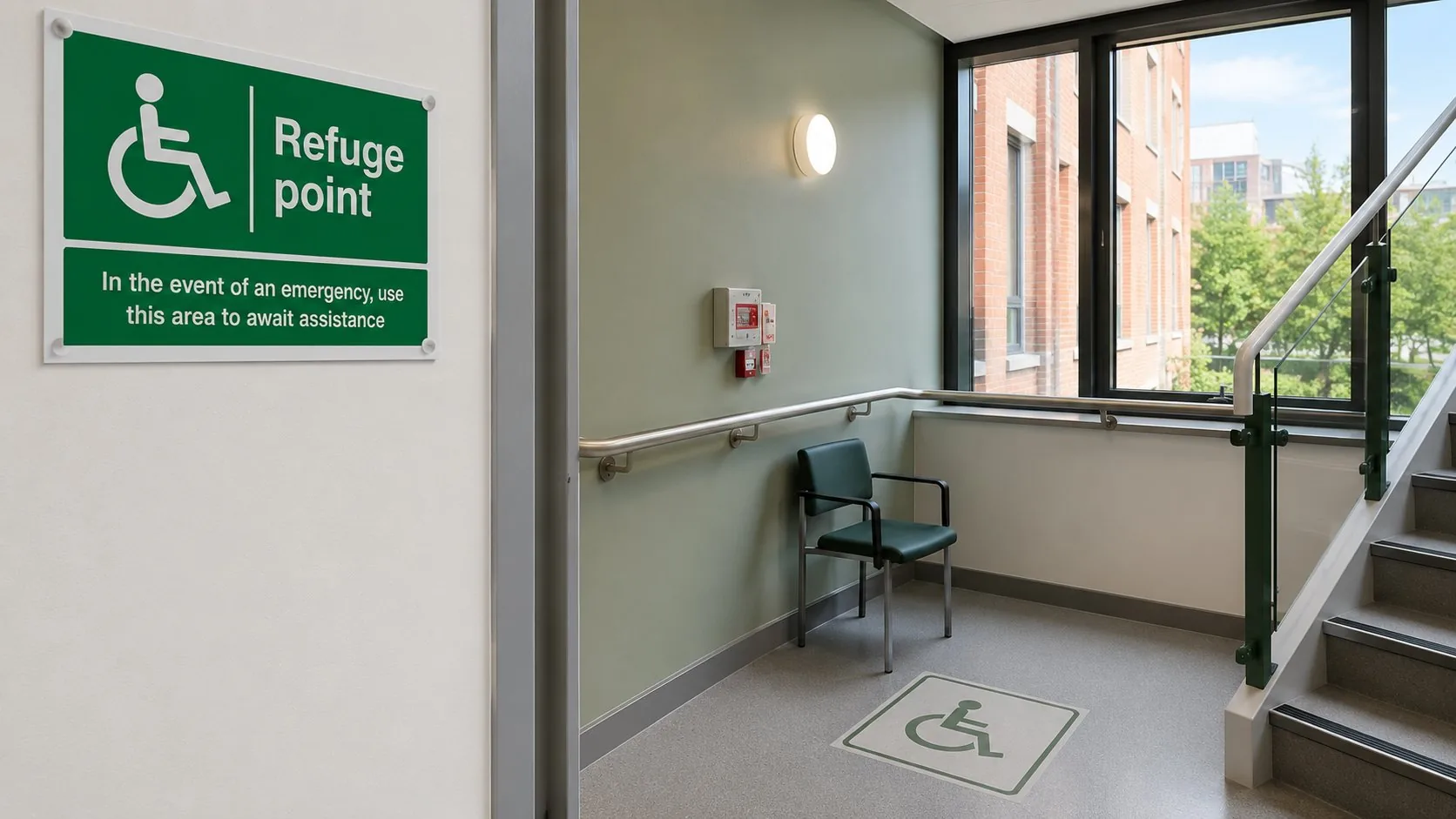
- Refuge point
- Emergency phone
- First aid
Fire equipment / fire safety signs (red rectangle)
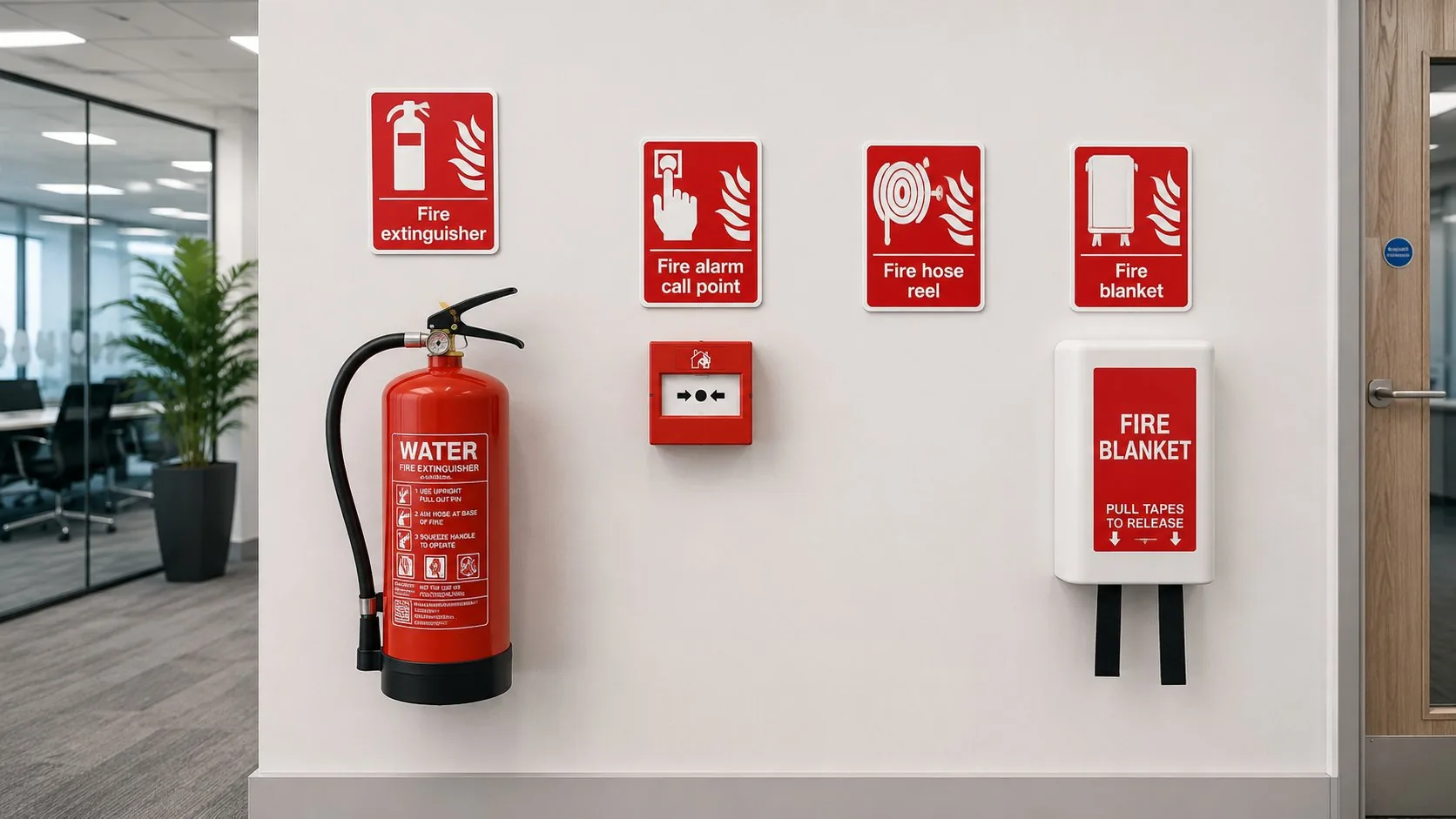
Firefighting-equipment signs use a white pictogram on a red square or rectangle.
Common examples:
- Fire extinguisher location
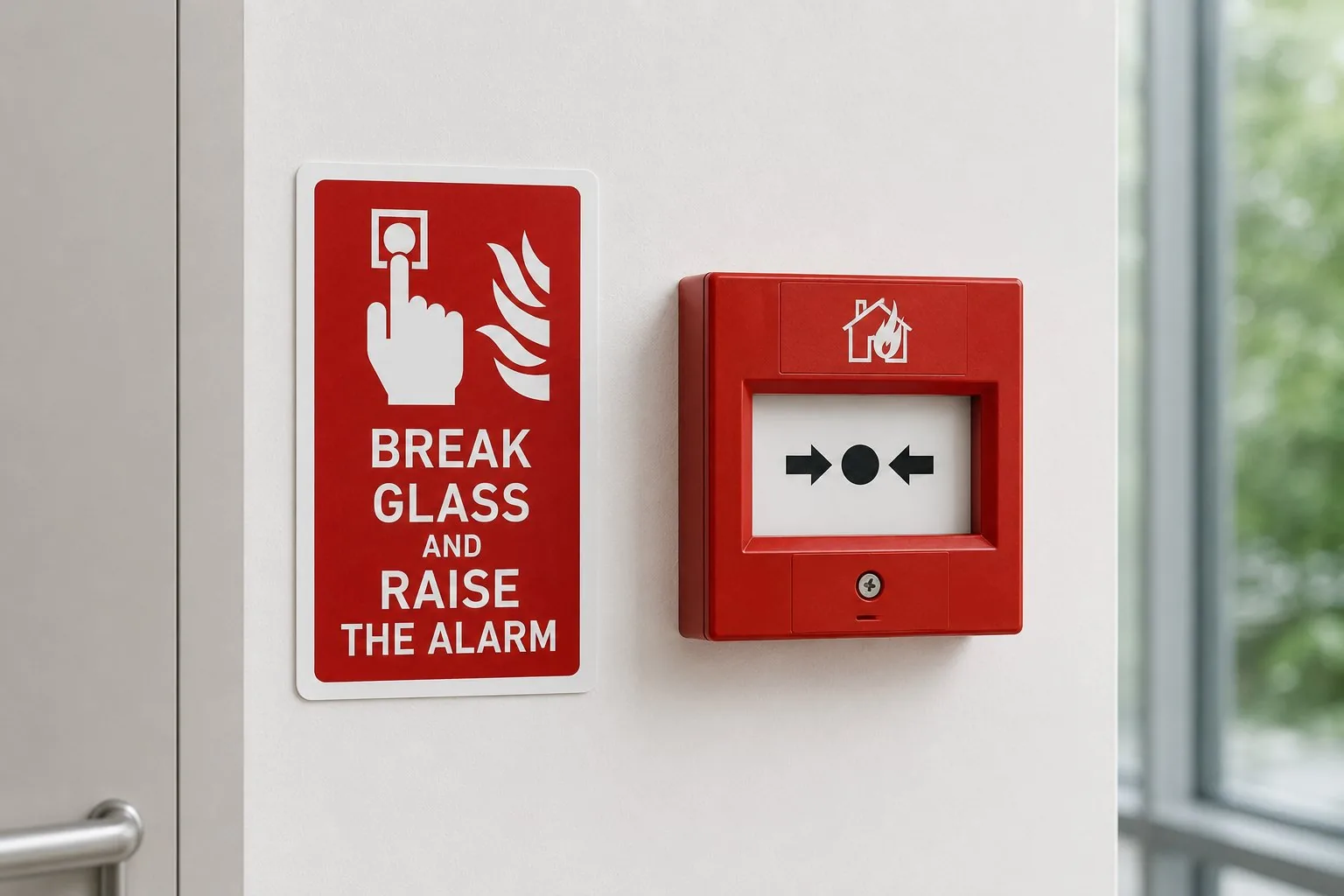
- Fire alarm call point
- Fire hose reel
- Fire blanket
Selecting signs for the workplace
Select signs from the risks and the emergency plan. The examples below serve different purposes; every workplace does not necessarily need every example.
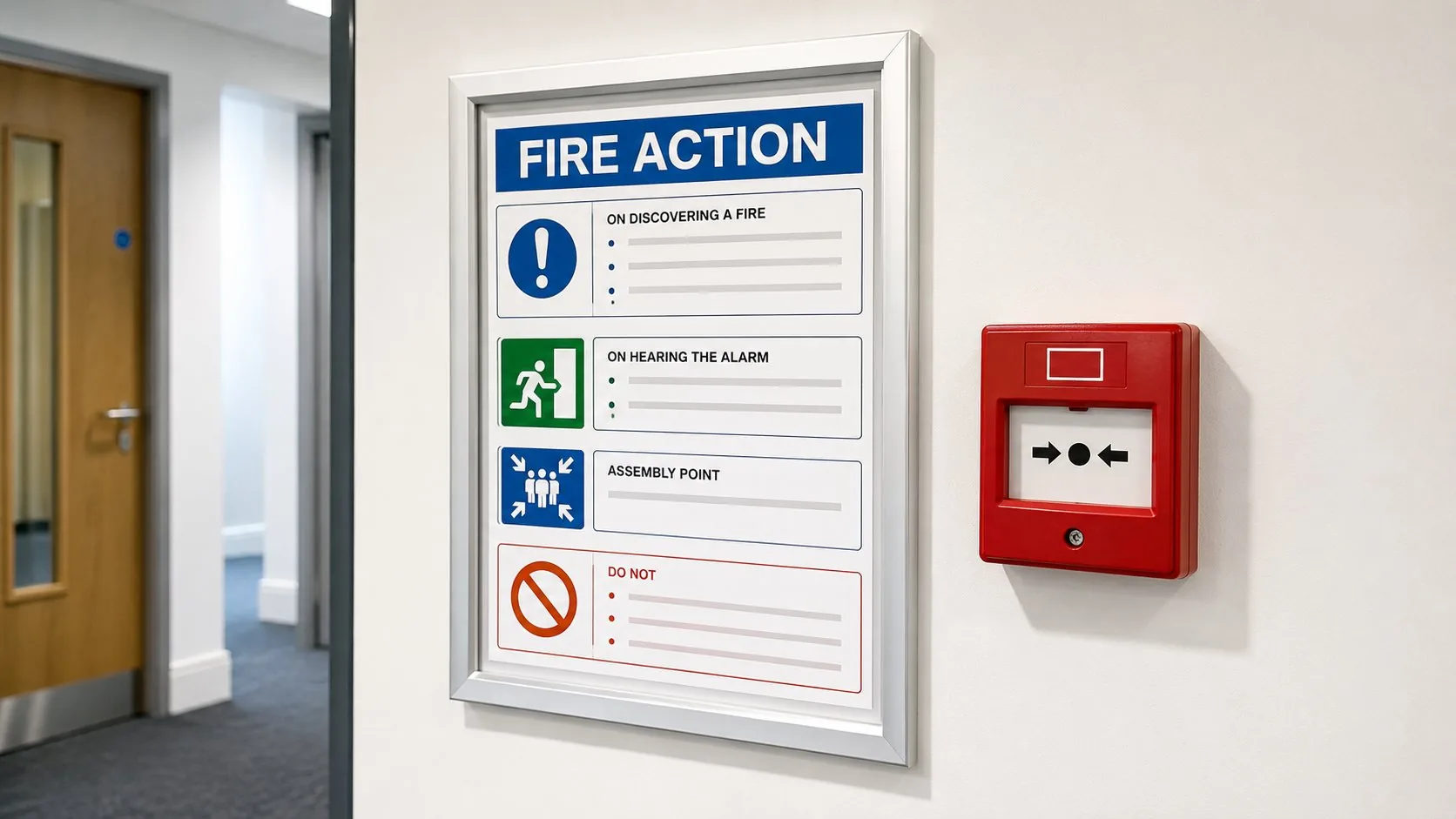
Fire action notices
Place fire-action notices where needed to explain the local procedure, commonly near alarm call points. State how to raise the alarm, summon help and evacuate under that premises’ plan, including any specific lift or assistance arrangements.
Fire exit signs
Use recognised exit pictograms and appropriate directional arrows to make the route unambiguous. Position signs at decision points where needed. Do not assume the final exit sign must omit its arrow; select the correct symbol and direction for the location.
Assembly point signs
Identify the designated assembly location clearly and tell occupants how to reach it. It should be safe and should not obstruct emergency access; it need not always be visible from every building exit.

Refuge point signs
Identify a refuge as a temporary place of relative safety within the assisted-evacuation plan. Communication and onward assistance must be arranged; do not tell people simply to wait there for firefighters.
Fire alarm call point signs
Red rectangles indicating where to break the glass and raise the alarm. Standard symbol with optional text.
Fire extinguisher ID signs
Use recognised signs to identify equipment locations where necessary. Any supplementary extinguisher-type information must agree with the actual unit’s ratings and instructions.

Fire door signage
Use door instructions appropriate to the door’s function and fire strategy, such as keep shut, keep locked or automatic fire door keep clear. Do not assume identical signs belong on every door or that an escape door should be locked against evacuation.

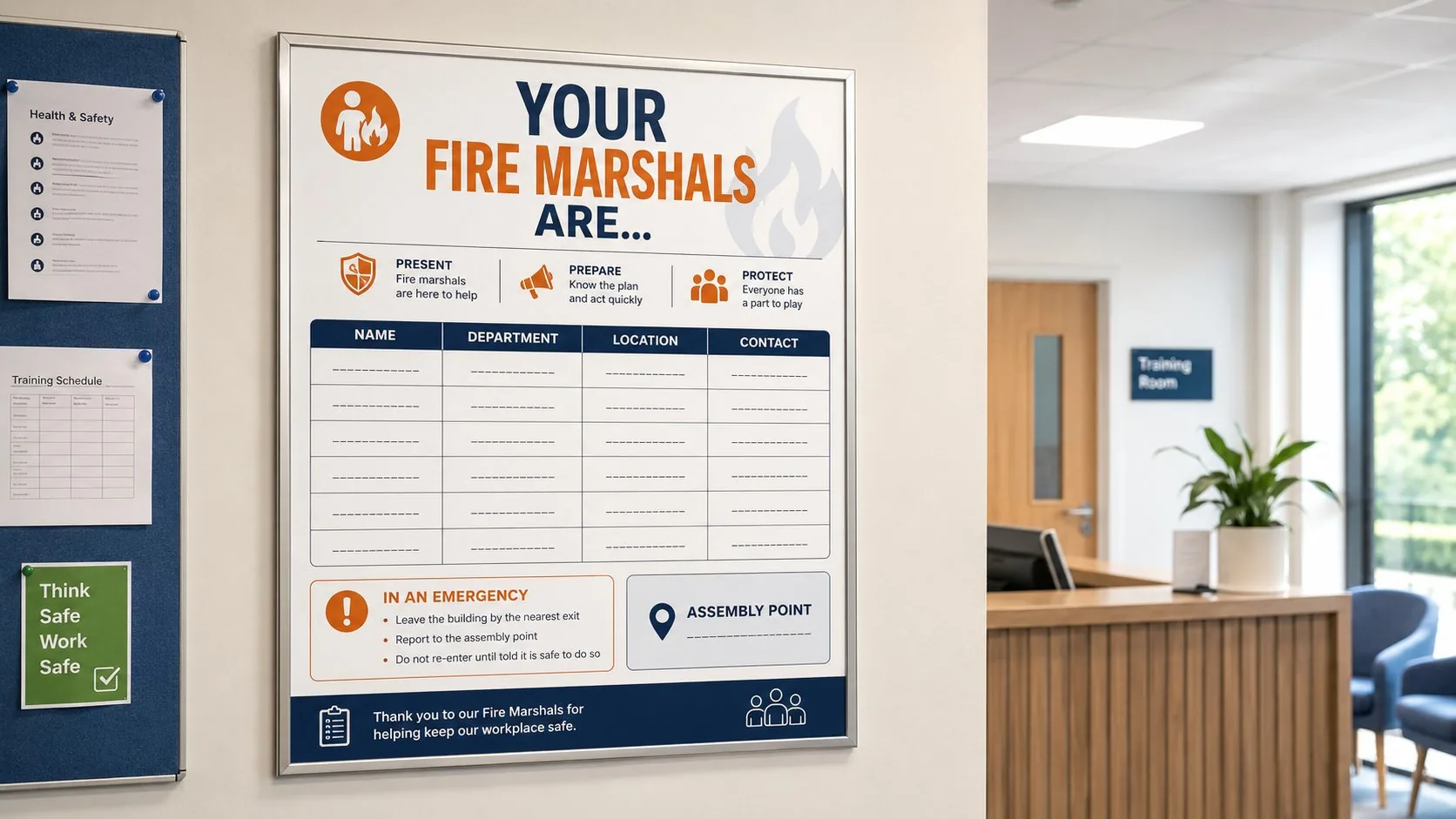
"Your fire marshals are…" identification poster
A workplace-specific notice listing the current fire marshals or fire wardens — names, locations within the building, and contact details where appropriate. This isn't required by law but it's standard practice in well-organised workplaces. Helps new starters and visitors know who to listen to.
Sign placement and visibility
Adequate signage is signage people can actually see when they need it. The detail matters more than people realise.
Position at decision points
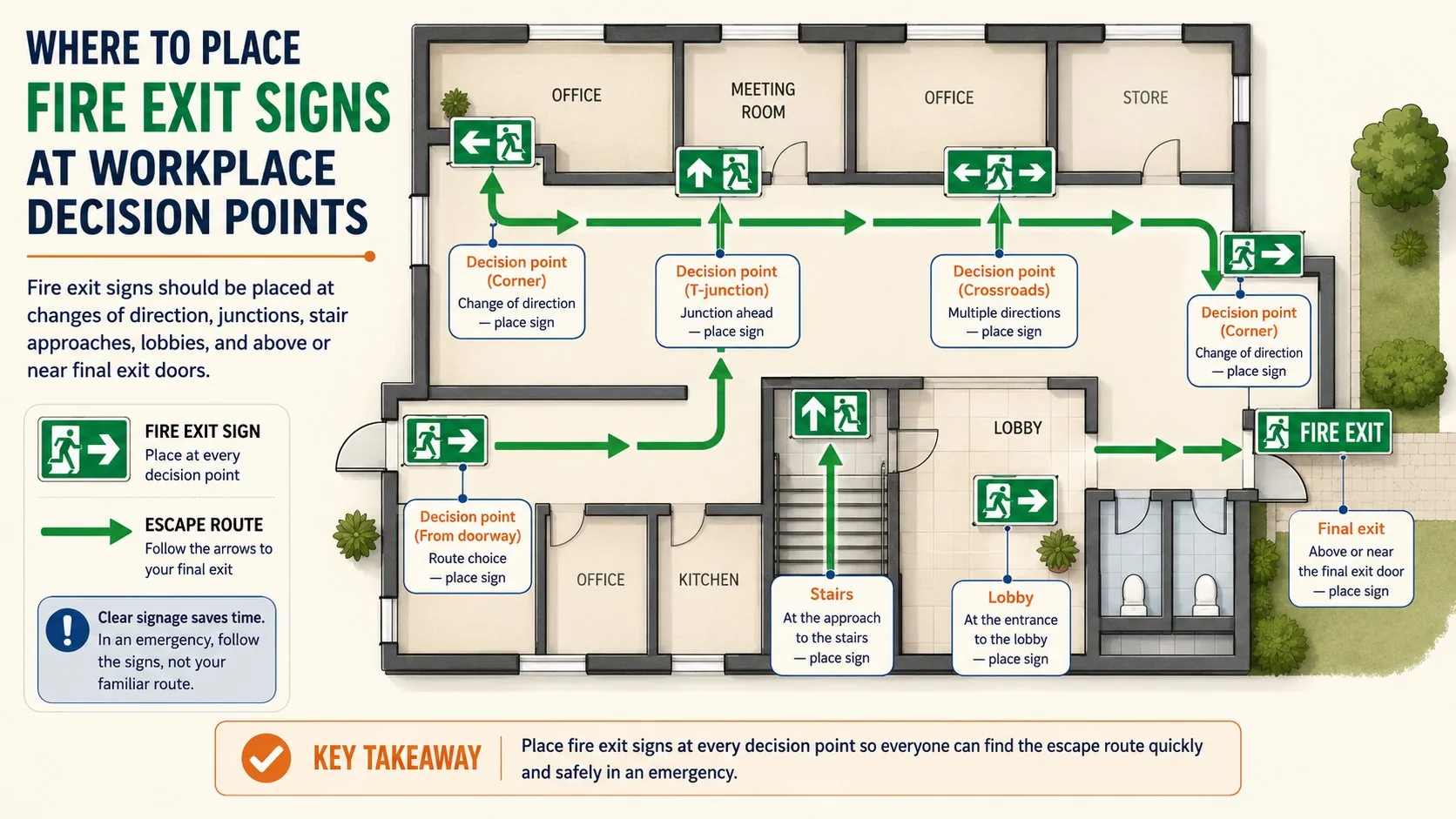
Fire exit signs should be at every point where someone might have to choose which way to go — corners, junctions, top and bottom of stairs, lobbies. Don't assume people remember the route from a single sign at the entrance.
Consistent height
Position signs for clear sightlines and consistent wayfinding, considering doors, obstructions and occupants. There is no universal 1.7–2.0 metre mounting height suitable for every sign and location.

Adequate illumination
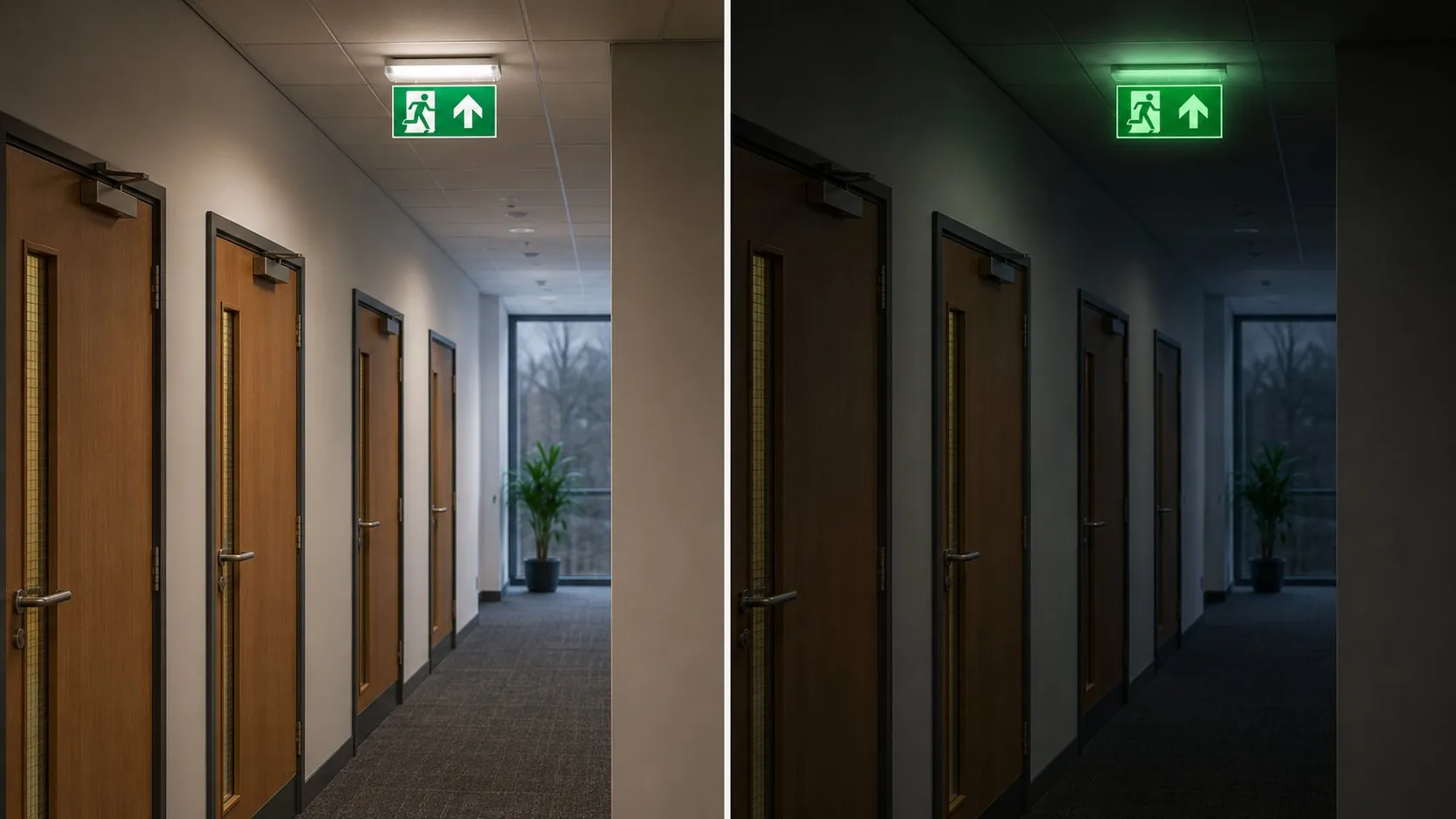
Signs must remain visible when needed. Provide suitable lighting and emergency illumination where required by the assessment. Photoluminescent signs need adequate charging light and are not an automatic substitute for emergency escape lighting.
Visibility from distance
Select sign dimensions and performance for the actual viewing distance, lighting and surroundings. A generic “standard size”, 100 lux or 17 metre rule cannot establish visibility for every sign.

Consistent symbols
Use consistent, recognisable symbols and directions along the route. Avoid conflicting signs; assess the actual system rather than treating standards labels alone as proof of compatibility.
No obstruction
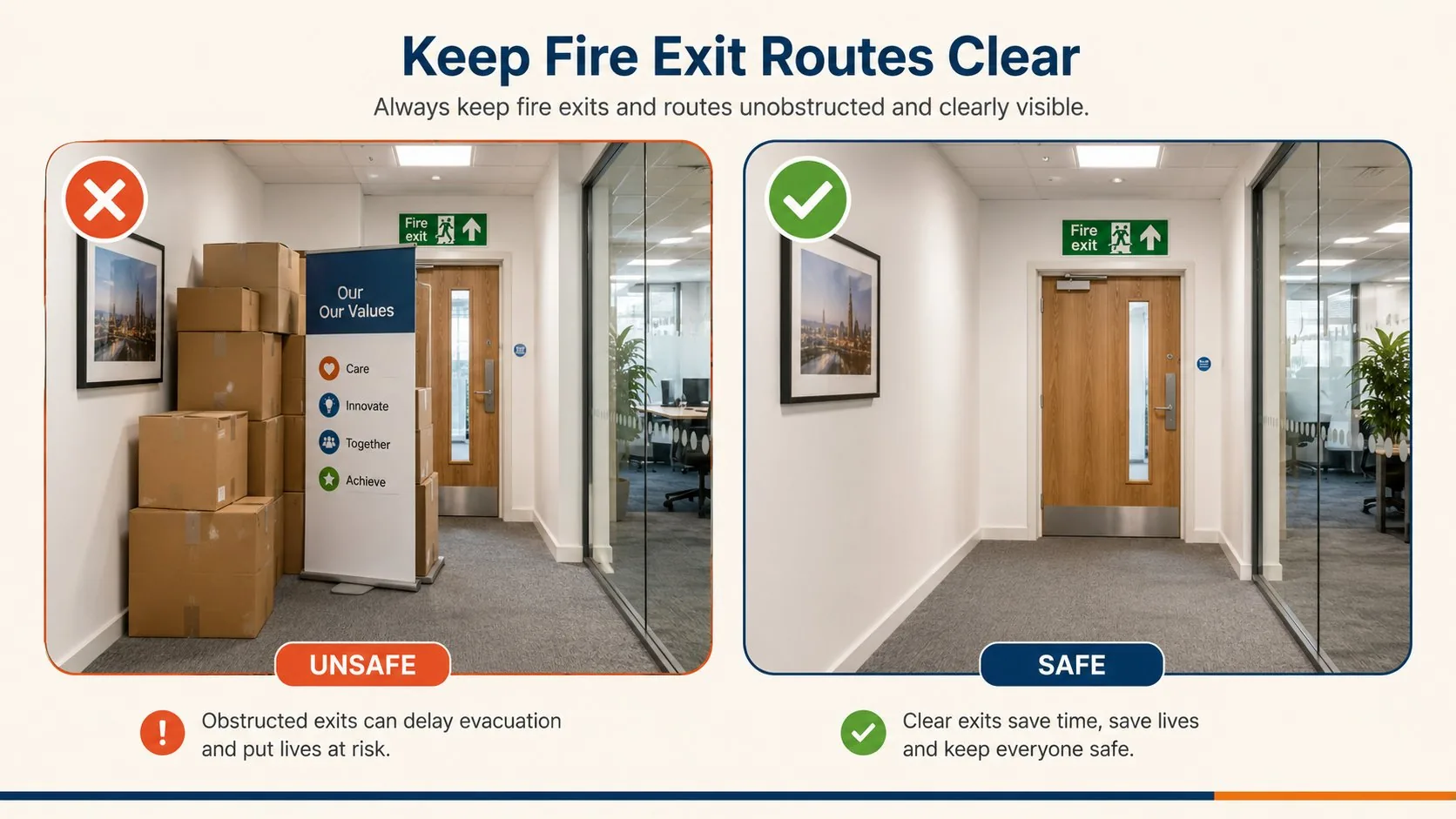
Signs blocked by ducting, plant growth, banners, posters or stacked goods aren't doing their job. Routine fire safety checks should include a sweep for signs that have become obscured.
Illustrative workplace examples
The examples below illustrate local fire-safety information. They are not fillable PDF templates or certified signs. Prepare the actual notices from the workplace’s arrangements and select permanent signs to suit the required visibility, materials and illumination.
- Fire marshal identification poster — an example of names and contact information to keep current when staff change. View the illustration.
- Fire action notice — an example layout. The actual notice must reflect the premises’ alarm, emergency call and evacuation procedures. View the illustration.
- Assembly point sign — an example of identifying the designated location; choose suitable materials and dimensions for the real site. View the illustration.
Use materials suitable for the environment and maintain legibility. Lamination alone does not establish weather resistance, photoluminescent performance or compliance; keep the information current.
Common questions
What size should fire safety signs be?
Choose dimensions using the relevant sign specification, viewing distance and lighting conditions. There is no universal 25 mm-per-metre rule for every sign and installation.
Are signs with text only legal?
Use recognised pictograms where safety-sign requirements apply, with supplementary text if helpful. Text alone should not replace the required symbol for an escape route or equipment sign.
Can I print my own fire safety signs?
You can prepare local information posters, but permanent safety signs must meet the actual requirements for symbols, dimensions, materials and visibility. Check these before relying on a printed template.
What about temporary signage during refurbishment?
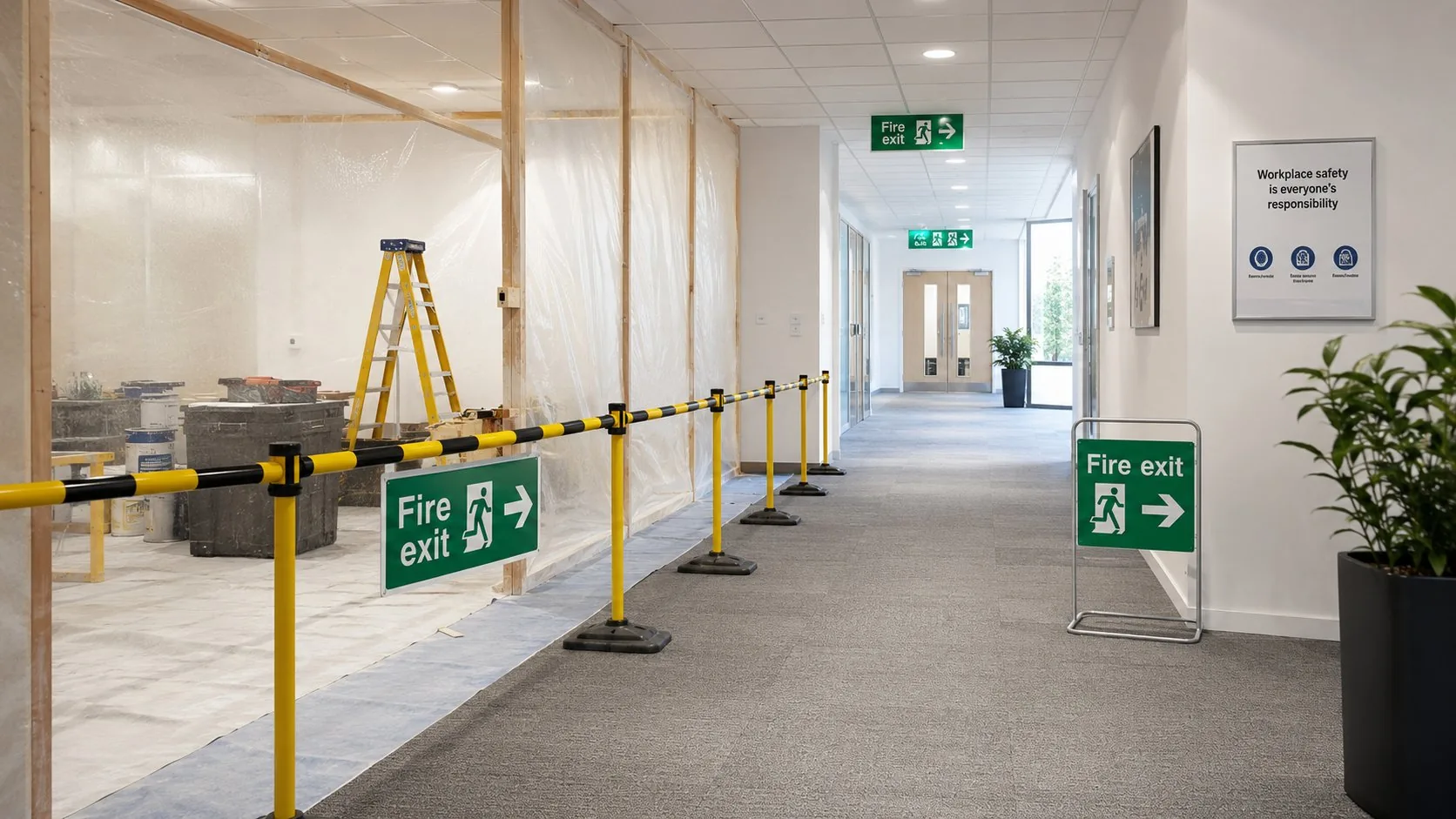
Refurbishment that affects escape routes or equipment locations needs temporary signage in place from day one. Temporary signs should still meet the basic standards — they don't have to be permanent installations but they do have to be visible and clear. Plan the temporary signage as part of the refurbishment programme, not as an afterthought.
Does the colour code apply across all UK workplaces?
The broad conventions are red for prohibition/fire equipment, yellow for warning, blue for mandatory actions and green for safe conditions. Shape and pictogram distinguish the categories, and the applicable national rules must also be met.
For the broader fire marshal role and how signage fits into routine duties, see the fire marshal responsibilities page and the fire marshal checklist — both cover signage checks as part of the regular workplace inspection.
If you're equipping a workplace from scratch, our Fire Warden Training course covers signage standards alongside the broader role. £18 per learner, RoSPA approved and CPD accredited, 60 to 90 minutes online, instant certificate on completion, with bulk discounts from 10 delegates upwards. Our wider fire safety advice — including signage tailored to your specific workplace — comes through the fire risk assessment process.
Related guides
- Fire marshal checklist: daily, weekly and emergency procedure
- Equipment and identification: fire marshal guide
- Fire marshal test questions: practice quiz with answers
Sources & references
Official guidance checked on 15 October 2026. Requirements vary by UK nation and premises.
- Legislation — Fire Safety Order, including articles 13, 15, 18, 21 and 23
- Government — duties under fire safety legislation
- Government — office and shop fire precautions, checks and training
- HSE L64 — safety signs, symbols and visibility
- Government — refuges and assisted evacuation
- Legislation — Safety Signs and Signals Regulations 1996
Make sure your team is trained to recognise fire safety signage and carry out their fire warden duties with confidence.
Explore the Fire Warden Training course →
Mark writes about workplace health & safety, fire warden training and accredited online training for Fire Warden Training, part of Online CPD Academy.